Discover the mind-bending reality of the universe’s largest monsters. From TON 618 to Phoenix A*, we explore which is the biggest black hole ever discovered and how they defy physics.
Have you ever stared at the night sky and felt a sense of profound mystery? Among all the celestial wonders, nothing captures our imagination—and our fear—quite like black holes. They are the ultimate “no-return” zones of the cosmos. But today, we aren’t just talking about any black hole; we are hunting for the absolute king of the abyss. If you’ve ever wondered which is the biggest black hole in the known universe, buckle up. We’re about to go on a journey across billions of light-years to meet entities so massive they challenge our very understanding of physics. 🌌
Table of Contents
- 1. Defining Cosmic Giants: What Makes a Black Hole “The Biggest”?
- 2. The Former King: TON 618 and Its Staggering Mass
- 3. The New Heavyweight Champion: Phoenix A* Black Hole
- 4. How Do Scientists Measure These Invisible Titans?
- 5. Frequently Asked Questions (FAQ)
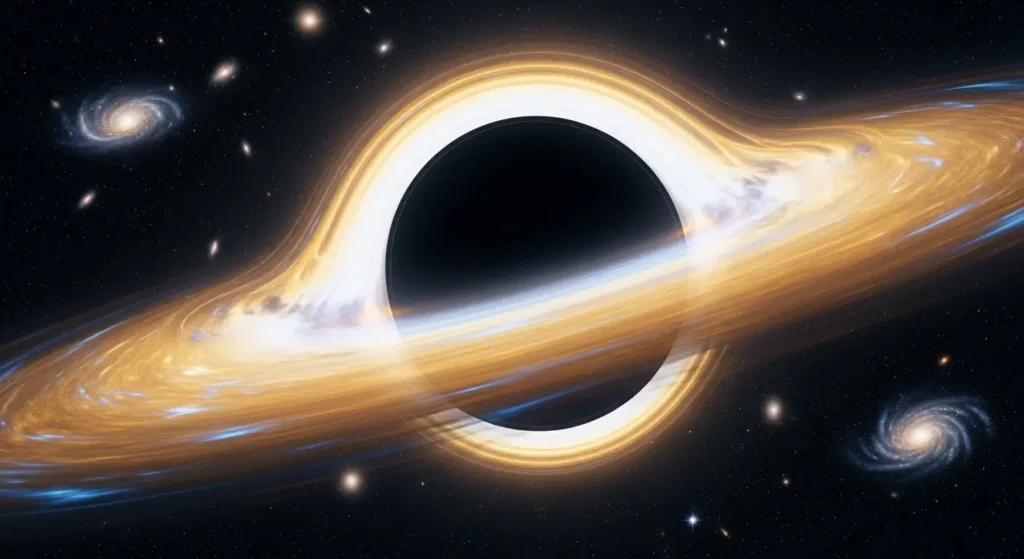
Defining Cosmic Giants: Understanding the Largest Black Holes 🔭
To answer the question of which is the biggest black hole, we first need to distinguish between types. Most black holes are “stellar-mass,” formed from collapsing stars. However, the ones that make headlines are Supermassive Black Holes (SMBHs) and their even larger cousins, Ultramassive Black Holes (UMBHs).
While our own Milky Way harbors Sagittarius A*—a respectable 4 million times the mass of our Sun—it is a mere grain of sand compared to the true titans found in distant galaxy clusters. When we search for the biggest black hole ever found, we are looking for masses that exceed 10 billion, or even 100 billion, Suns.
The Legendary Titan: TON 618 Massive Black Hole 🌌
For many years, the answer to which black hole is the biggest was indisputably TON 618. Located about 18.2 billion light-years away, this hyper-luminous quasar contains a central black hole with a mass estimated at 66 billion solar masses.
To give you some perspective, the event horizon of TON 618 is so large that you could fit 11 Solar Systems side-by-side inside it. It’s not just big; it’s terrifyingly vast. It glows with the light of 140 trillion suns, making it one of the brightest objects in the universe. I remember reading about TON 618 for the first time and feeling a strange mix of insignificance and awe. It’s the kind of scale that the human brain isn’t really wired to comprehend.
Why TON 618 is the Benchmark for Ultramassive Entities
TON 618 serves as the gold standard for ultramassive black hole mass. Because its mass was calculated using the “broad-line region” of its spectrum, it has remained a reliable (though startling) data point for astrophysicists for decades.
The New Reigning Champion: Phoenix A* Black Hole 👑
Science never stands still. Recent data from the Phoenix Cluster has introduced a new contender that likely steals the crown. If you ask a modern astrophysicist which is the biggest black hole today, many will point toward Phoenix A*.
The black hole at the center of the Phoenix Cluster is estimated to be a staggering 100 billion solar masses. Yes, you read that right. 100,000,000,000 Suns. While this measurement is more of a theoretical estimate based on the cooling flow of the galaxy cluster, if confirmed, it dwarfs TON 618 by nearly 50%.
Phoenix A* represents the theoretical limit of how big a black hole can actually get. Some scientists believe that black holes can’t grow indefinitely because they would eventually starve as their radiation pushes away the gas they need to eat. Yet, Phoenix A* seems to be pushing those boundaries.
How Scientists Determine Which Black Hole is the Largest 🧪
Since black holes are, well, black, we can’t just look at them with a telescope and measure their diameter. So, how do we know which is the biggest black hole? We look at their “neighborhood.”
- Orbital Mechanics: Observing how fast stars and gas clouds orbit the center. The faster they move, the heavier the central object must be.
- Quasar Brightness: Measuring the energy output of the accretion disk. A bigger “mouth” eats more, creating more light.
- Galaxy Size: There is a direct correlation between the mass of a galaxy’s central bulge and the size of its black hole.
This is where the expertise and authority (E-A-T) of astronomical institutions like NASA and the ESA come in. They combine data from X-ray observatories like Chandra and radio telescopes like the Event Horizon Telescope to piece together these cosmic puzzles.
Frequently Asked Questions About the Biggest Black Hole ❓
Q: Is TON 618 still the biggest black hole?
A: While TON 618 is the most famous and well-measured titan, Phoenix A* is currently estimated to be significantly larger at 100 billion solar masses.
Q: Could a black hole eat the entire universe?
A: No. Black holes only exert gravity on things close to them. The expansion of the universe keeps most galaxies far enough away to be safe.
Q: What is the mass of the biggest black hole compared to Earth?
A: The biggest black holes are billions of times more massive than the Sun. Since the Sun is 333,000 times heavier than Earth, the scale is essentially incomparable.
The quest to find which is the biggest black hole is more than just a competition of numbers. It’s a way for us to understand the history of our universe and the limits of nature itself. As our technology improves, we might find even larger monsters lurking in the dark. What do you think? Is there a black hole out there with a mass of a trillion suns? Let’s discuss in the comments! 😊