Explore the complex Starship Mars landing sequence, from the critical Raptor engine ignition to the high-stakes final descent. This technical deep dive explains how SpaceX intends to conquer the Martian atmosphere and achieve a soft landing on the Red Planet.
Table of Contents
- 1. Atmospheric Entry: The First Hurdle of the Mars Landing Sequence
- 2. Raptor Engine Ignition: The Heart of the Starship Landing Manuever
- 3. The Belly Flop and Landing Flip: Physics in Motion
- 4. The Final Descent: Precision Control for a Soft Landing
- 5. Technical Challenges of Propulsive Landing on Mars
- 6. Frequently Asked Questions (FAQ)
Landing a massive spacecraft on Mars is often described as “seven minutes of terror,” but for SpaceX’s Starship, the stakes and the scale are entirely different. Unlike previous rovers that used parachutes and sky cranes, Starship relies on a purely propulsive Starship Mars landing sequence. This transition from a high-velocity orbital entry to a pinpoint final descent is a masterpiece of modern aerospace engineering.
I’ve spent years tracking the evolution of the Raptor engine and the iterative testing at Starbase. What we are seeing is not just a bigger rocket; it’s a fundamental shift in how we approach interplanetary travel. To understand how humanity will set foot on Mars, we must first master the engine ignition and the physics of the Martian atmosphere.
Atmospheric Entry: The First Hurdle of the Mars Landing Sequence 🚀
The journey to the surface begins at nearly 7.5 kilometers per second. Mars has an atmosphere that is only 1% as thick as Earth’s—thick enough to burn you up if you aren’t careful, but too thin to slow you down sufficiently using drag alone. This “Goldilocks” problem is why the Starship Mars landing sequence is so unique.
Starship utilizes its vast surface area in a “belly flop” orientation to maximize atmospheric drag. During this phase, the vehicle’s heat shield—composed of thousands of hexagonal silica tiles—must withstand temperatures exceeding 1,500 degrees Celsius. The goal here is “aerobraking”: shedding over 90% of the kinetic energy without using a single drop of propellant. It’s a delicate dance of plasma and thermal protection systems.
Raptor Engine Ignition: The Heart of the Starship Landing Manuever 🔥
As the craft reaches the lower, thicker layers of the atmosphere, the most critical moment arrives: the engine ignition. For Starship, this isn’t just a simple “on” switch. It involves the rapid startup of the Raptor engines while the vehicle is falling horizontally.
The Raptor engine, fueled by sub-cooled liquid methane (CH4) and liquid oxygen (LOX), is designed for extreme reliability and relight capability. During the engine ignition phase, the onboard computers must initiate the turbopumps, stabilize the combustion chamber pressure, and verify thrust vectors in a matter of seconds. On Mars, where there is no GPS and a significant communication delay with Earth, this process must be entirely autonomous.
💡 Pro Insight: The use of Methane is strategic. Through the Sabatier process, future Martians can manufacture rocket fuel directly from the Martian atmosphere (CO2) and subsurface ice (H2O), making the return trip possible.
The Belly Flop and Landing Flip: Physics in Motion 🔄
The most visually stunning part of the sequence is the “landing flip.” After falling horizontally to maximize drag, the Starship must transition to a vertical orientation for its final descent. This requires a coordinated burst from the Raptor engines to “kick” the tail of the ship downward.
This maneuver is incredibly high-risk. We saw this during the early SN8 through SN11 tests at Boca Chica. If the engine ignition is uneven or the fuel tanks (headers) lose pressure during the flip, the vehicle fails to stabilize. SpaceX solved this by using dedicated “header tanks” located in the nose and center, ensuring that the engines have a steady flow of propellant even as the ship tumbles and rotates.
The Final Descent: Precision Control for a Soft Landing 📍
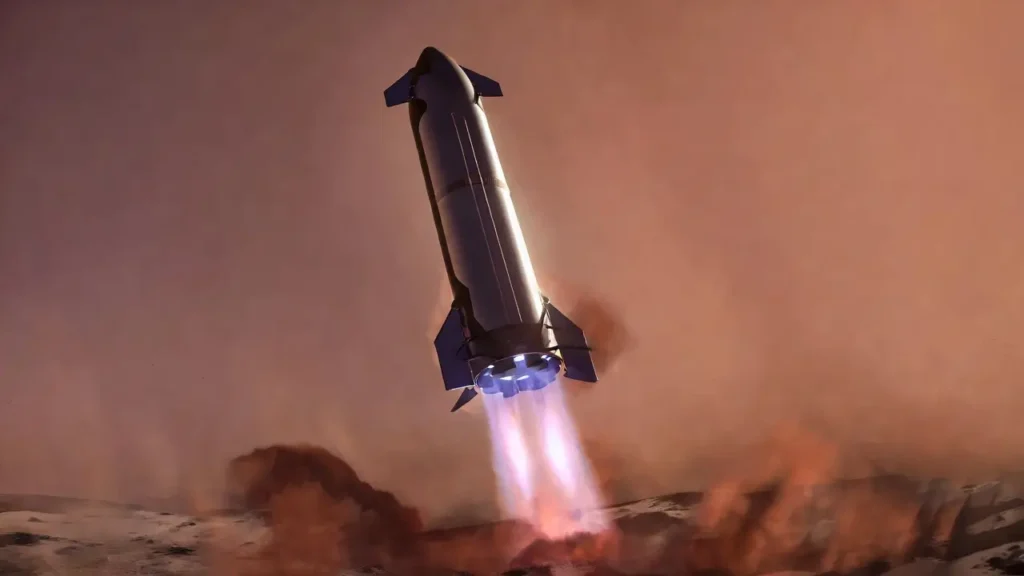
Once vertical, the final descent begins. At this stage, the Starship is a few kilometers above the Martian regolith. The engines throttle down with incredible precision to counteract gravity. Unlike Earth, Mars has about 38% of Earth’s gravity, which actually makes the propulsive landing slightly more forgiving in terms of thrust-to-weight ratio, but the lack of air means the control surfaces (flaps) become useless, leaving the engines to do 100% of the steering through gimbaling.
In the final seconds of the Starship Mars landing sequence, the craft uses Terrain Relative Navigation (TRN). This AI-driven system scans the ground for boulders, craters, and uneven slopes, adjusting the final descent path in real-time to find a safe “parking spot.” The landing legs deploy, and the engines shut off the moment sensors detect contact with the ground.
Technical Challenges of Propulsive Landing on Mars ⚠️
| Challenge Factor | Impact on Landing | SpaceX Solution |
|---|---|---|
| Low Air Density | Parachutes are ineffective for heavy loads. | Full Propulsive Descent |
| Dust Obscuration | Landing plume kicks up “brown out” dust. | Pulse Radar & Lidar Sensors |
| Engine Reliability | Deep space cold start is difficult. | Vacuum-optimized Raptor ignition |
One of the “unspoken” challenges is the plume-surface interaction. The Raptor engines are so powerful that they could potentially dig a crater underneath the ship during the final descent, leading to instability. Experts suggest that early Mars missions might involve landing on pre-deployed pads or using specific throttle techniques to minimize surface erosion.
Frequently Asked Questions (FAQ) ❓
Q: How long does the Starship Mars landing sequence take?
A: From atmospheric entry to touchdown, the process takes approximately 6 to 7 minutes, depending on the entry angle and atmospheric conditions.
Q: Can the Raptor engines restart in deep space?
A: Yes, the Raptor engines are designed with integrated spark igniters rather than pyro-technics, allowing for multiple restarts during the mission.
Q: Why doesn’t Starship use parachutes on Mars?
A: Starship is too heavy (over 100 tons of cargo). Parachutes large enough to slow it down would be impossibly heavy and complex. Propulsive landing is the only scalable solution.
The road to Mars is paved with iterations. Each Starship test brings us closer to making this landing sequence a reality. Do you think we’ll see a successful Mars landing by 2029? Let me know your thoughts in the comments below! 🚀✨