Discover what kind of star the Sun really is, how it powers life on Earth, and the timeline of its ultimate demise. A deep dive into solar fusion, space weather, and the Sun’s Red Giant future.
Have you ever looked up at the sky and wondered, “What exactly is that blinding ball of fire?”
We see it every day, yet we often take it for granted. The Sun is not just a static light bulb in the sky; it is a raging, dynamic celestial powerhouse. Holding 99.8% of the solar system’s total mass, it is the undisputed ruler of our cosmic neighborhood. Without it, Earth would be a frozen, lifeless rock drifting in the void.
But here is the sobering truth: The Sun is not eternal.
In this article, we will explore the scientific nature of the Sun, the mechanics of its massive energy production, the turbulent “space weather” that affects our daily lives, and finally, the spectacular, cataclysmic ending that awaits it (and us) billions of years from now. Let’s journey into the heart of our star. 😊
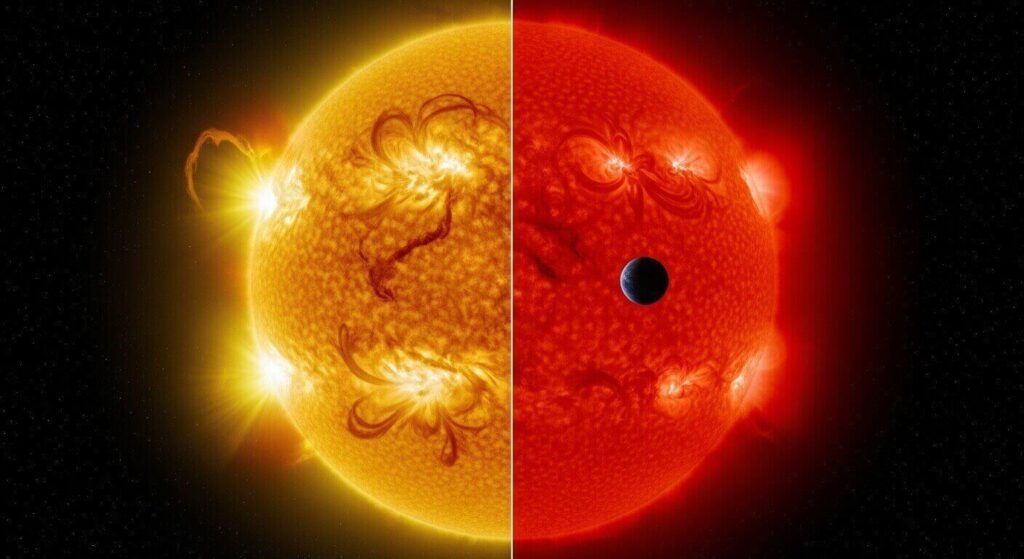
Table of Contents
- 1. The Sun’s Identity: A G-Type Main-Sequence Star
- 2. The Nuclear Furnace: How the Sun Creates Energy
- 3. Solar Cycles and Space Weather: The Sun’s Temper
- 4. The Ozone Layer: Our Shield Against Stellar Fury
- 5. The End of the Sun: Red Giants and White Dwarfs
- 6. Conclusion: A Call for Balance
- 7. Frequently Asked Questions (FAQ)
1. The Sun’s Identity: A G-Type Main-Sequence Star ⭐️
Astronomically speaking, our Sun is classified as a G-type main-sequence star, often informally called a “Yellow Dwarf.” It formed approximately 4.6 billion years ago from the gravitational collapse of matter within a region of a large molecular cloud.
While it looks massive to us, the Sun is actually an average-sized star compared to the giants of the universe. However, its influence is anything but average. It anchors the gravity of the entire solar system, keeping everything from massive Jupiter to tiny asteroids in orbit.
💡 Did You Know?
The Sun is essentially a perfect sphere of hot plasma, heated to incandescence by nuclear fusion reactions in its core. It radiates this energy mainly as visible light, ultraviolet light, and infrared radiation.
2. The Nuclear Furnace: How the Sun Creates Energy ☢️
The Sun isn’t burning like a campfire; it’s a massive nuclear reactor. The secret lies in its Core, where temperatures soar to a staggering 15 million degrees Celsius (27 million degrees Fahrenheit).
The Magic of Nuclear Fusion
At the core, extreme pressure and heat force hydrogen atoms to smash together and fuse into helium. This process is called nuclear fusion.
- Every second, the Sun converts about 600 million tons of hydrogen into helium.
- This process releases an immense amount of energy in the form of photons (light) and neutrinos.
It takes sunlight only 8 minutes and 19 seconds to travel the 93 million miles to Earth. This energy drives our planet’s weather, ocean currents, seasons, and climate, and makes plant life possible through photosynthesis.
3. Solar Cycles and Space Weather: The Sun’s Temper 🌪️
Contrary to what it seems, the Sun is not calm. It is a magnetic mess. The Sun undergoes an 11-year solar cycle, shifting between periods of quiet (Solar Minimum) and extreme activity (Solar Maximum).
Sunspots and Magnetic Twisting
Because the Sun is fluid, its equator spins faster than its poles. This phenomenon, known as differential rotation, causes the Sun’s magnetic fields to stretch, twist, and tangle like rubber bands. When these magnetic fields punch through the surface, they create Sunspots—cooler, darker areas on the Sun’s surface.
Solar Flares and CMEs
When these tangled magnetic lines snap, they release explosive bursts of energy known as Solar Flares. Sometimes, this is accompanied by a Coronal Mass Ejection (CME), hurling billions of tons of plasma into space.
If a CME hits Earth, it interacts with our magnetosphere, causing:
- Geomagnetic Storms: Can disrupt GPS and radio communications.
- Power Grid Failures: Strong storms can overload electrical grids.
- Auroras: Beautiful Northern and Southern Lights seen at lower latitudes.
4. The Ozone Layer: Our Shield Against Stellar Fury 🛡️
While the Sun gives life, it also emits dangerous Ultraviolet (UV) radiation. Exposure to unshielded solar radiation would be fatal for life on Earth.
This is where the Ozone Layer comes in. Situated in the stratosphere, this layer of gas absorbs the majority of the Sun’s harmful UV rays. Without this protective shield, intense UV radiation would sterilize the Earth’s surface, destroying the food chain starting from microscopic plankton and plants.
⚠️ Warning:
Human activities that deplete the ozone layer essentially poke holes in our only defense against solar radiation. Protecting this layer is critical for the survival of all species.
5. The End of the Sun: Red Giants and White Dwarfs ⏳
Nothing lasts forever, not even stars. We are currently about halfway through the Sun’s life cycle. But what happens when the fuel runs out?
Step 1: The Red Giant Phase (Approx. 5 Billion Years from Now)
When the Sun exhausts the hydrogen in its core, gravity will crush the core while the outer layers expand dramatically. The Sun will swell into a Red Giant.
In this terrifying expansion, the Sun will grow large enough to swallow the orbits of Mercury and Venus. Earth will likely be engulfed or scorched into a molten rock, evaporating all oceans and ending all life as we know it.
Step 2: The Planetary Nebula
The outer layers of the Red Giant will eventually drift off into space, creating a beautiful glowing shell of ionized gas known as a planetary nebula.
Step 3: The White Dwarf
All that remains will be the ultra-dense, hot core, roughly the size of Earth. This is the White Dwarf. It will produce no new energy, simply slowly cooling and fading over trillions of years into a black dwarf.
6. Conclusion: A Call for Balance 🌍
The Sun is both a creator and a destroyer. By understanding the Sun, we gain insight into the mechanics of the universe and the fragility of our own existence.
As we burn fossil fuels, we are rapidly releasing ancient solar energy stored over millions of years, destabilizing the climate balance that the Sun and Earth have maintained. Our survival depends not just on the Sun continuing to shine, but on our ability to live in harmony with the energy it provides.
While the Sun’s death is billions of years away, the lessons it teaches us about sustainability and atmospheric protection are relevant today.
7. Frequently Asked Questions (FAQ) ❓
Q: When will the Sun die?
A: The Sun is expected to run out of hydrogen fuel in about 5 billion years, entering its Red Giant phase.
Q: Will the Sun explode as a Supernova?
A: No. The Sun does not have enough mass to explode as a supernova. Instead, it will shed its outer layers and shrink into a dense White Dwarf.
Q: How hot is the Sun?
A: The surface of the Sun is about 5,500°C (9,932°F), but the core reaches temperatures of roughly 15 million°C.
Q: Can a solar storm destroy Earth?
A: A solar storm cannot physically destroy the planet, but a powerful “superflare” or CME could cause catastrophic damage to our technology, power grids, and satellites.
We hope this journey to our star was enlightening. The universe is full of wonders—keep looking up! If you have more questions about space, drop a comment below! 😊