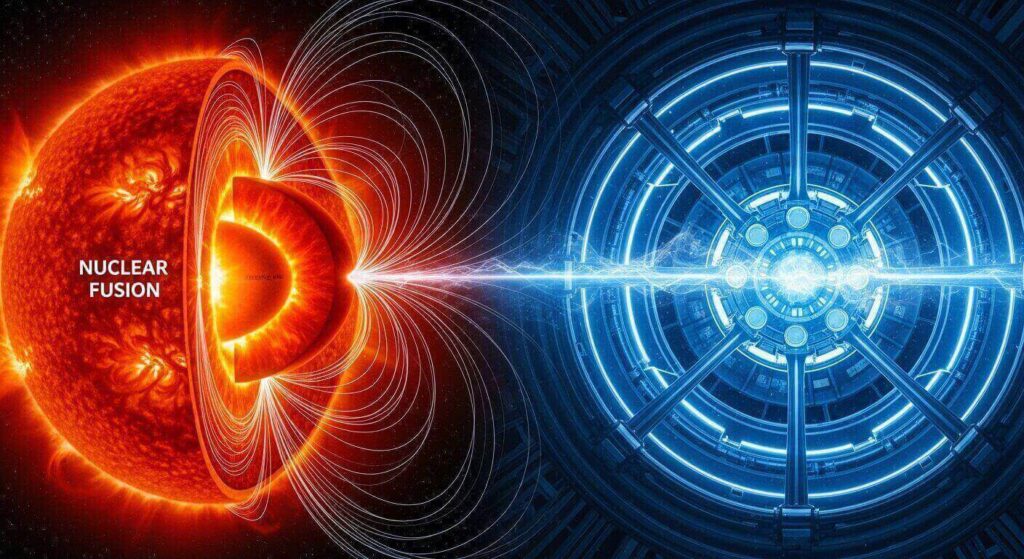
We see it every day. It’s the constant, unwavering presence in our lives that brings warmth, light, and life. But are we *too* comfortable with the Sun? We rely on this 4.6-billion-year-old star for everything, yet we rarely consider the sheer, untamed power blazing 93 million miles away. The Sun is not just a gentle lamp; it’s a raging nuclear furnace, a place of unimaginable violence. Its secrets—the very secrets of **nuclear fusion**—are the key to all life, and paradoxically, a potential threat to our modern civilization.
This isn’t just a topic for astronomers. Understanding the Sun’s power is a quest for human survival. It’s about predicting devastating space weather and, even more profoundly, about harnessing that same power here on Earth. This is the story of our star, its volatile secrets, and the quest to build our own. 😊
Table of Contents
- 1. The Sun’s Engine: What is Nuclear Fusion?
- 2. A Dynamic Star: Solar Activity and Its Earthly Impact
- 3. Peering into the Heart: How We Study the Sun’s Secrets
- 4. Replicating the Sun: The Promise of Nuclear Fusion Energy
- 5. The Sun’s Future and Ours
- 6. Frequently Asked Questions
The Sun’s Engine: What is Nuclear Fusion?
Every second, the Sun converts about 600 million tons of hydrogen into helium. This process, **stellar nucleosynthesis**, is the secret to its energy. But it’s not a simple fire. It’s a precise and violent nuclear reaction.
The Proton-Proton Chain: A Cosmic Recipe
In the Sun’s core, the temperature reaches an insane 15 million degrees Celsius (27 million °F), and the pressure is over 250 billion times that of Earth’s atmosphere. In this environment, matter ceases to be gas, liquid, or solid. It becomes **plasma**, a superheated soup of charged particles. [Image of the Sun’s Proton-Proton Chain reaction steps]
Here, a process called the Proton-Proton Chain reaction occurs. Four hydrogen nuclei (protons) are forced together through a multi-step process. Despite their natural repulsion (like trying to force two powerful positive magnets together), the immense pressure and temperature make them fuse. The end product is one helium nucleus.
Crucially, the new helium nucleus weighs slightly *less* than the four original hydrogen nuclei. This “lost” mass isn’t truly lost. It is converted directly into a tremendous amount of energy, following Albert Einstein’s famous equation: E=mc². This tiny bit of mass, multiplied by the speed of light squared, is the source of all the Sun’s heat and light.
The Gravitational Balancing Act
With all this explosive energy pushing outwards, why doesn’t the Sun just blow itself apart? The answer is gravity.
The Sun exists in a perfect, 5-billion-year-old stalemate called hydrostatic equilibrium.
- Outward Pressure: The nuclear fusion in the core generates a powerful outward push (radiation pressure).
- Inward Pull: The Sun’s own immense mass creates a crushing gravitational force, pulling everything inward.
This celestial “tug-of-war” is what keeps our star stable, allowing it to burn steadily for billions of years, providing the stable conditions necessary for life to evolve on Earth.
A Dynamic Star: Solar Activity and Its Earthly Impact
The Sun’s stability is internal. Its surface, however, is a chaotic and violent place. This activity is driven by the Sun’s incredibly complex and tangled magnetic fields.
Sunspots, Flares, and Coronal Mass Ejections (CMEs)
As the Sun rotates, its plasma and magnetic fields twist and churn. Sometimes, these magnetic field lines get so tangled that they snap like a rubber band, releasing an enormous burst of energy. This is the source of the Sun’s most violent weather: [Image of Sunspots, Solar Flares, and CMEs diagram]
- Sunspots: These are cooler, darker patches on the surface, marking areas of intense magnetic activity. They are the “staging grounds” for solar storms.
- Solar Flares: A sudden, intense burst of radiation (X-rays and UV light) from a sunspot. Traveling at the speed of light, this radiation can reach Earth in just 8 minutes, causing radio blackouts.
- Coronal Mass Ejections (CMEs): These are the *real* heavy-hitters. A CME is a massive eruption of solar plasma—billions of tons of charged particles—hurled into space at millions of miles per hour.
The Threat of Geomagnetic Storms: From Carrington to Quebec
When a CME slams into Earth’s magnetic field (the magnetosphere), it triggers a geomagnetic storm. While this can create beautiful auroras (Northern and Southern Lights), a powerful storm can be catastrophic to our high-tech society.
History has given us clear warnings:
- The 1989 Quebec Blackout: A moderate geomagnetic storm induced powerful electrical currents in the ground, overloading and collapsing the entire power grid of Quebec, Canada, in just 90 seconds.
- The 1859 Carrington Event: This is the “big one.” The most powerful storm on record, it was so intense that auroras were seen in the Caribbean. It set telegraph offices on fire and electrocuted operators. If a Carrington-level event happened today, it could cripple global power grids, destroy satellites (GPS, communications), and cause trillions of dollars in damage, potentially taking a decade to repair.
Peering into the Heart: How We Study the Sun’s Secrets
We can’t send a probe into the Sun’s core. So how do we know all this? Science has developed ingenious ways to “see” the unseeable.
Neutrinos: The Ghost Messengers
The nuclear fusion reactions in the Sun’s core release tiny, nearly massless particles called neutrinos. These “ghost particles” are fascinating because they barely interact with matter at all. A neutrino can pass through the entire Earth without hitting a single atom.
This makes them the perfect messengers. While a photon of light may take 100,000 years to “random walk” its way out of the dense core, a neutrino flies out at nearly the speed of light, reaching us in 8 minutes. By building massive detectors deep underground (like the Sudbury Neutrino Observatory in Canada) to shield them from other radiation, scientists can catch these elusive particles. Their detection is direct, real-time proof of the nuclear reactions happening in the Sun’s core *right now*.
Probing the Corona: NASA’s Parker Solar Probe
To understand solar flares and the solar wind, we must get closer. NASA’s Parker Solar Probe is doing just that. Launched in 2018, this groundbreaking mission is “touching the Sun.” It is flying directly through the Sun’s outer atmosphere, the corona, enduring extreme heat and radiation.
Its mission is to find out why the corona (at 1 million °C) is hundreds of times hotter than the surface below (at 5,500 °C) and to discover the mechanism that accelerates the solar wind. This data is critical for improving our “space weather” forecasts and protecting our technology.
Replicating the Sun: The Promise of Nuclear Fusion Energy
Understanding the Sun’s secrets isn’t just about defense; it’s about imitation. For over 70 years, humanity has been on a quest for the “holy grail” of energy: harnessing **nuclear fusion energy** on Earth.
Why Pursue Fusion Energy?
The promise is almost limitless. Unlike fission (which splits heavy, radioactive atoms), fusion (which joins light atoms) offers:
- Abundant Fuel: The primary fuels, deuterium and lithium (to breed tritium), are available in seawater and are virtually inexhaustible.
- No Carbon Emissions: It’s a completely clean energy source.
- Inherent Safety: A fusion reaction is not a chain reaction. It’s incredibly difficult to start and even harder to maintain. If any problem occurs, the plasma simply cools, and the reaction stops. A “meltdown” is physically impossible.
- No Long-Lived Radioactive Waste: It does not produce the high-level, long-lasting nuclear waste that fission plants do.
The Enormous Challenges and the ITER Project
So, what’s the catch? It turns out that replicating a star’s core on Earth is the single hardest engineering challenge humanity has ever attempted. To achieve fusion, we must heat the plasma fuel to over 150 million degrees Celsius—ten times hotter than the core of the Sun.
No material on Earth can contain this. The solution is a “magnetic bottle.” The most promising design is a doughnut-shaped device called a Tokamak. It uses immensely powerful superconducting magnets to suspend the superheated plasma in a vacuum, preventing it from touching the walls.
This is the goal of ITER, a massive international collaboration building the world’s largest tokamak in southern France. ITER is not designed to produce electricity, but to achieve the long-awaited milestone: “ignition,” or net energy gain. That is, to finally get more energy *out* of the fusion reaction than the energy we put *in* to heat it. Recent breakthroughs, like the one at the National Ignition Facility (NIF) in the US (using a different method), have achieved this for the first time, proving that, physically, it is possible.
The Sun’s Future and Ours
Our Sun is middle-aged, about halfway through its 10-billion-year life. It will burn steadily for another 4 to 5 billion years. Eventually, when it runs out of hydrogen in its core, its gravitational balance will fail. It will swell into a **Red Giant**, expanding to engulf Mercury, Venus, and possibly Earth. After this final, cataclysmic phase, it will shed its outer layers and its core will cool into a faint, dense ember: a **White Dwarf**. [Image of the Sun’s life cycle diagram (Main Sequence to Red Giant to White Dwarf)]
This distant, cosmic end is not our concern. Our concern is the present. The Sun’s secrets are twofold: the physics of its power and the timing of its danger. We are in a race to understand both. By studying the Sun, we learn to protect our fragile technological world from its flares. And by imitating the Sun, we may unlock a clean, sustainable future for all of humanity. Our survival, in more ways than one, depends on understanding this magnificent, terrible, and life-giving star.
Frequently Asked Questions about the Sun and Fusion Energy
What’s the difference between nuclear fusion and nuclear fission?
They are opposites. Nuclear Fission is the process used in today’s nuclear power plants. It works by splitting a large, heavy atom (like Uranium-235) into smaller ones, which releases energy. Nuclear Fusion is the process of combining (fusing) two small, light atoms (like hydrogen) into a larger one, which releases even more energy. Fission is easier to control but produces long-lived radioactive waste. Fusion is the power of stars, is incredibly difficult to control, but is far cleaner and safer.
Could a solar flare really destroy Earth?
No, a solar flare cannot “destroy” the planet itself. The Earth’s atmosphere and magnetic field protect life on the surface from the radiation. However, a massive geomagnetic storm (from a CME, not just a flare) could destroy our modern technological civilization. It wouldn’t blow up buildings, but by collapsing the power grid, it would stop the flow of water, halt transportation, spoil food supplies, and shut down communications. This is why predicting space weather is a critical matter of national security.
When will we have commercial fusion energy?
This is the “running joke” in physics, where the answer has always been “in 30 years.” However, we are genuinely closer than ever before. The scientific consensus is that we will see the first grid-scale *prototype* power plants in the 2040s. While this is a long way off, the recent scientific breakthroughs in achieving net energy gain (ignition) mean it is no longer a question of “if,” but “when.”
What is the Sun’s “Solar Cycle”?
The Sun’s magnetic activity operates on a regular, 11-year cycle. It goes from a period of low activity (Solar Minimum, with very few sunspots) to a period of high activity (Solar Maximum, with many sunspots and frequent solar flares/CMEs). We are currently in Solar Cycle 25 and are approaching the Solar Maximum, which is why you may hear more news about auroras and solar storms in the coming year or two.
How does the Sun’s magnetic field work?
It’s incredibly complex, but the simple answer is the “dynamo effect.” The Sun is a rotating ball of conductive plasma. Because the Sun’s equator rotates faster (25 days) than its poles (35 days)—a phenomenon called differential rotation—it stretches and twists the magnetic field lines, like winding up a rubber band. This twisting and tangling is what stores up massive amounts of energy, which is then released as flares and CMEs when the field lines “snap.”