The universe is filled with entities that defy human imagination. We often think of stars and galaxies as the titans of the cosmos, but lurking in the deep shadows are monsters that make our entire solar system look like a speck of dust. Among these, black holes are the most terrifying and fascinating. But there is one that reigns supreme—the “King of Black Holes.”
Today, we are diving deep into the abyss to explore TON 618. It is not just a black hole; it is an ultramassive beast that challenges our understanding of physics and the history of the universe. Buckle up, because the scale of what we are about to discuss is truly mind-boggling.
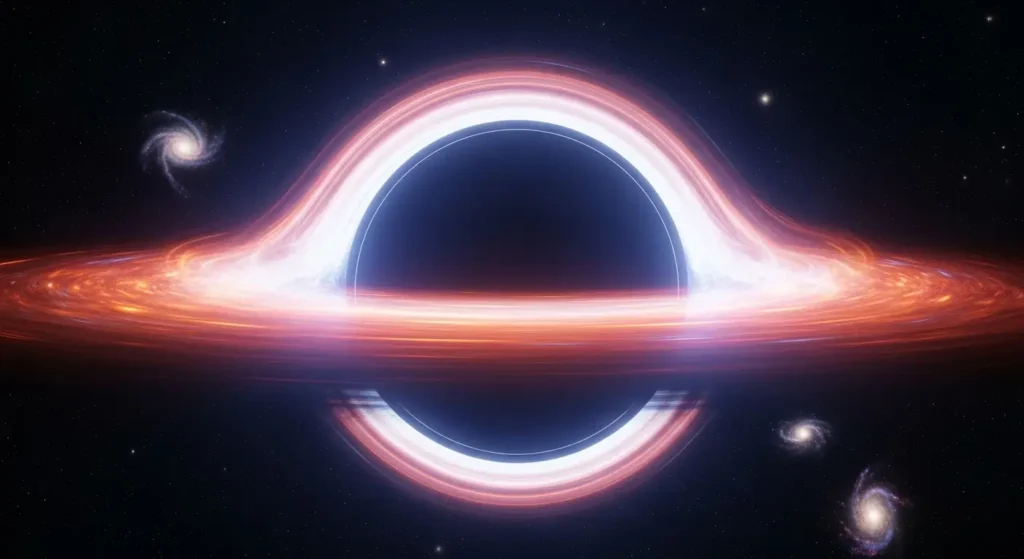
Table of Contents
- 1. What is TON 618? From “Blue Star” to Quasar Monster
- 2. The Mind-Bending Mass and Size of TON 618
- 3. A Shining Abyss: The Brightness of a Quasar
- 4. The Physics of the Extreme: Gravity and Time Dilation
- 5. The Great Cosmic Mystery: How Did TON 618 Get So Big?
- Frequently Asked Questions (FAQ)
1. What is TON 618? From “Blue Star” to Quasar Monster
When astronomers at the Tonantzintla Observatory in Mexico first cataloged TON 618 in 1957, they had no idea what they were looking at. Through their telescopes, it appeared to be nothing more than a faint, violet-blue star. It was cataloged as number 618 in the Tonantzintla catalogue—hence the name.
However, as radio astronomy technology advanced in the 1970s, scientists realized that this “star” was emitting powerful radio waves. Detailed spectroscopic analysis revealed something shocking: this object was not a star inside our galaxy. It was a Quasar (Quasi-Stellar Radio Source) located a staggering 18.2 billion light-years away (based on comoving distance).
So, what exactly is a Quasar?
A quasar is essentially an extremely active galactic nucleus. At its center lies a supermassive black hole that is feeding on matter with such ferocity that the friction and gravity heat the surrounding material to millions of degrees. This process releases more energy than hundreds of galaxies combined. TON 618 is the engine powering one of the most luminous quasars ever observed.
2. The Mind-Bending Mass and Size of TON 618
To understand why TON 618 is called the “King,” we need to talk numbers. But be warned: the scale of this ultramassive black hole is almost impossible for the human mind to comprehend.
66 Billion Solar Masses
The mass of TON 618 is estimated to be 66 billion times the mass of our Sun. To put that into perspective, the supermassive black hole at the center of our own Milky Way galaxy, Sagittarius A*, is only about 4 million solar masses. TON 618 is roughly 15,000 times more massive than the monster holding our galaxy together.
Swallowing the Solar System Whole
Black holes are defined by their Event Horizon—the point of no return where not even light can escape. The diameter of TON 618’s event horizon is approximately 390 billion kilometers (about 242 billion miles).
Let’s visualize this:
- Neptune’s Orbit: Neptune orbits the Sun at a distance of about 4.5 billion km. TON 618 is nearly 43 times wider than Neptune’s entire orbit.
- Voyager 1: Voyager 1 has been traveling for over 45 years and is the furthest human-made object from Earth. It would take Voyager centuries just to cross the diameter of TON 618.
If you replaced our Sun with TON 618, Earth would not just be swallowed; the entire solar system would disappear deep within its abyss, occupying a tiny fraction of its volume.
3. A Shining Abyss: The Brightness of a Quasar
It sounds contradictory, but this black hole is one of the brightest objects in the universe. While the black hole itself is invisible, the accretion disk swirling around it is blindingly bright.
The gas and dust spiraling into TON 618 are moving at immense speeds, generating incredible friction. This creates a luminosity equivalent to 140 trillion Suns. It outshines the combined light of the entire Milky Way galaxy thousands of times over. This extreme brightness is the only reason we can detect it from such a vast distance. If it weren’t feeding, it would be a silent, invisible sleeping giant in the dark.
4. The Physics of the Extreme: Gravity and Time Dilation
In the vicinity of TON 618, the laws of physics as we experience them are pushed to their breaking point. This object is a playground for Einstein’s Theory of General Relativity.
- Gravitational Lensing: The gravity is so intense that it bends the fabric of space-time. Light passing behind TON 618 would be bent around it, creating a distorted halo or “Einstein Ring.”
- Time Dilation: As you approach the event horizon, time begins to warp. To a distant observer, a clock falling toward TON 618 would appear to tick slower and slower until it freezes completely at the edge.
- Spaghettification? Maybe not: Paradoxically, because TON 618 is so large, the tidal forces at the event horizon are actually weaker than those of a small black hole. You might potentially cross the point of no return without being instantly ripped apart—though your ultimate fate would still be sealed.
5. The Great Cosmic Mystery: How Did TON 618 Get So Big?
TON 618 presents a significant problem for modern astrophysics. The light we see from TON 618 originated when the universe was only about 3.4 billion years old.
The question is: How did it get so massive, so quickly?
Standard models suggest black holes grow by merging with others or slowly absorbing matter. However, there simply wasn’t enough time since the Big Bang for a black hole to reach 66 billion solar masses through standard feeding rates (limited by the Eddington limit).
Scientists have proposed several theories to explain this ultramassive anomaly:
- Direct Collapse Black Holes: In the early universe, massive clouds of pristine gas might have collapsed directly into a giant black hole, skipping the “star” phase entirely. This would create a much heavier “seed” to start with.
- Super-Eddington Accretion: Perhaps in the chaotic early universe, black holes could feed much faster than the theoretical limit allowed, gorging on dense matter at unprecedented rates.
TON 618 serves as a crucial laboratory for understanding the conditions of the early cosmos and the evolution of galaxies.
TON 618 is not just a celestial body; it is a reminder of the sheer scale of the cosmos. It humbles us and challenges us to look deeper into the dark. As technology like the James Webb Space Telescope continues to peer back in time, we may soon uncover even more secrets about these titans of the deep universe.
Frequently Asked Questions (FAQ)
Is TON 618 the largest black hole ever discovered?
Yes, as of current confirmed observations, TON 618 holds the record for the most massive black hole known, at roughly 66 billion solar masses. There are theoretical models for larger ones (like Phoenix A*), but TON 618 remains the heavyweight champion of confirmed measurements.
Can we see TON 618 from Earth?
Not with the naked eye. Despite being incredibly bright as a quasar, it is over 10 billion light-years away. You would need a powerful telescope to detect it as a faint point of light.
Is TON 618 a threat to Earth?
Absolutely not. TON 618 is located billions of light-years away. Its gravity, while immense, has zero influence on our solar system. The expansion of the universe is actually carrying it further away from us every second.
What is an Ultramassive Black Hole?
While “Supermassive” describes black holes up to a few billion solar masses, astronomers use the term “Ultramassive” for those extreme outliers that exceed 10 billion solar masses, like TON 618.