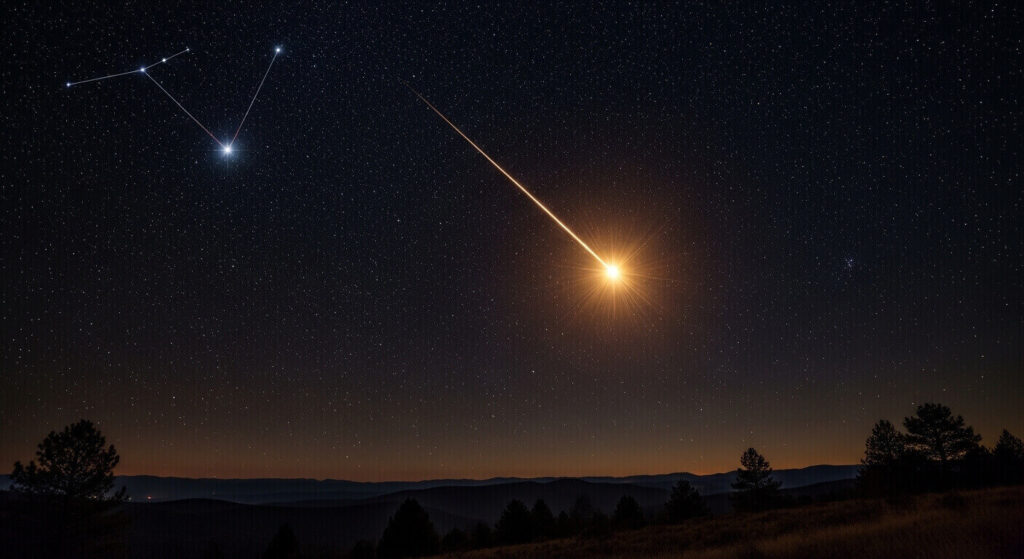
Have you ever stared up at the night sky and seen a “shooting star” blaze across the darkness? It’s a magical experience. But what if I told you there’s a celestial event coming up known for producing spectacular, super-bright meteors called fireballs?
This isn’t just any meteor shower. This is the 2025 Northern Taurids, peaking on November 11-12. As an astronomy enthusiast who has spent countless nights under the stars, I can tell you the Taurids are special. They’re not a “storm” of meteors, but what they lack in quantity, they make up for in breathtaking quality.
In this expert guide, we’ll cover everything you need to know to witness this incredible event. We’ll break down the *what*, *when*, and *how*—including the crucial moon conditions—to give you the best possible chance to see a 2025 Taurid fireball.
On This Page:
- What Are the Northern Taurids?
- When to Watch: The 2025 Northern Taurids Peak (Nov 11-12)
- Why the 2025 Northern Taurids Are a “Must-See” (Fireballs!)
- Moon Conditions for the 2025 Peak: A Key Challenge
- Expert Tips for Observing the 2025 Northern Taurids
- Frequently Asked Questions (FAQ)
What Are the Northern Taurids? 🤔
The Taurid meteor shower isn’t a single event but a complex and broad stream of debris left behind by a fascinating object: Comet 2P/Encke. As Earth orbits the Sun, it plows through this wide trail of cosmic dust and pebbles every year in late October and November.
This debris stream is so wide that it’s actually split into two main branches:
- The Southern Taurids: These peak first, typically in late October or early November.
- The Northern Taurids: These peak about a week or two later, giving us the main event on November 11-12, 2025.
Because their active periods overlap, they essentially combine in early-to-mid-November, increasing your chances of seeing a spectacular meteor. The “Northern” and “Southern” names refer to their *radiant*—the point in the sky from which they appear to originate. For both, this point is in the famous constellation Taurus, the Bull.
When to Watch: The 2025 Northern Taurids Peak (Nov 11-12) 🗓️
Mark your calendars! The peak activity for the 2025 Northern Taurid meteor shower is expected on the night of Tuesday, November 11, into the early morning of Wednesday, November 12.
However, “peak” can be misleading. Unlike showers like the Perseids, which have a sharp, intense peak, the Taurids are a broad, rambling shower. You can see Taurid meteors for several weeks before and after this date.
The radiant (in Taurus) rises in the east around sunset and is high in the sky for most of the night, crossing the meridian (its highest point) after midnight. This means you can start watching as soon as it’s truly dark.
Why the 2025 Northern Taurids Are a “Must-See” (Fireballs!) 🔥
This is what truly sets the Taurids apart. This shower is renowned not for the *number* of meteors, but for their *quality*. The Zenithal Hourly Rate (ZHR)—the number of meteors you’d see per hour under perfect conditions—is low, only about 5 to 10 meteors per hour.
So why bother? Because the Taurids are rich in fireballs.
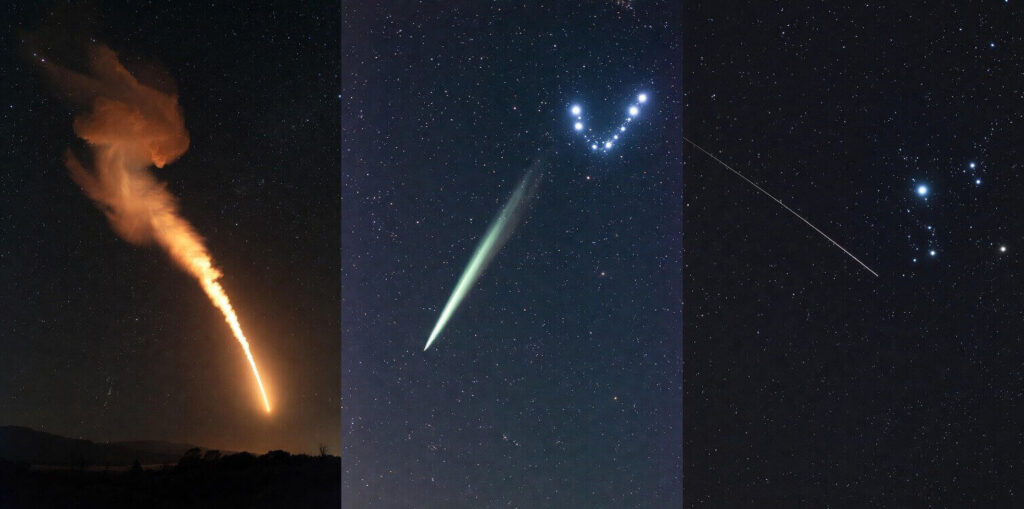
A fireball is a meteor that is exceptionally bright, defined by astronomers as being brighter than the planet Venus. The debris from Comet Encke is chunkier than typical meteor shower dust; we’re talking about pebbles or even small rocks. When these larger pieces hit our atmosphere, they burn up in spectacular, long-lasting streaks of light that can cast shadows on the ground and leave behind smoky trails.
Seeing one Taurid fireball can be more memorable than seeing dozens of faint meteors from another shower. It’s a game of patience and quality over quantity.
Moon Conditions for the 2025 Peak: A Key Challenge 🌕
Now for the critical information for 2025. The sky’s brightness is the number one enemy of meteor watching, and the Moon is the biggest culprit.
During the 2025 Northern Taurids peak (Nov 11-12), the Moon will be in its Third Quarter phase. This means it will be approximately 53% illuminated.
This might sound like bad news, but there is a crucial silver lining: a Third Quarter Moon rises late, around midnight.
Your 2025 Viewing Strategy:
This creates a perfect “window of opportunity.” The best time to observe the 2025 Northern Taurids will be in the evening of November 11.
- Start Time: As soon as the sky is completely dark (e.g., 8:00 PM).
- End Time: Around midnight, or whenever the Moon rises in your location and begins to wash out the sky.
This pre-midnight window gives you several hours of dark-sky viewing to hunt for those elusive fireballs.
Expert Tips for Observing the 2025 Northern Taurids 🔭
As someone who’s spent many cold nights waiting for meteors, here is my most practical advice.
- Escape City Lights: This is the most important rule. You *must* get away from light pollution. A dark rural location is best. Your eyes need to be in the dark to see faint meteors (and even fireballs look better).
- Be Patient (and Ditch the Phone): It takes your eyes about 20-30 minutes to fully adapt to the darkness. Don’t look at your bright phone screen, as it will ruin your night vision instantly.
- No Telescope Needed: Meteor watching is a naked-eye activity. Telescopes and binoculars have a narrow field of view, which means you’ll miss the meteors. You want to see as much sky as possible.
- Lie Back and Relax: The best way to watch is to lie on a reclining chair or a blanket on the ground. This saves your neck and gives you the widest view of the sky.
- Look Up, Not Just at Taurus: While the meteors *originate* from Taurus, they can appear anywhere in the sky. In fact, the meteors with the longest, most impressive tails will often be seen far from the radiant. A good strategy is to look about 45 degrees away from Taurus.
- Dress Warmer Than You Think: November nights are cold. You’ll be sitting still for a long time, so your body will get cold fast. Wear layers, a hat, gloves, and bring a warm drink.
Watching a meteor shower is a meditation. It teaches patience. But when that bright Taurid fireball finally streaks across the sky, the wait is worth it.
Frequently Asked Questions (FAQ) about the Northern Taurids ❓
Q: What’s the difference between the Northern and Southern Taurids?
A: They are two branches of the same debris stream from Comet Encke. The main differences are their timing and radiant. The Southern Taurids peak about a week or two earlier (late Oct/early Nov) and their radiant is slightly further south in the constellation Taurus.
Q: Do I need a telescope or binoculars to see the 2025 Northern Taurids?
A: No, in fact, you should *not* use them. Your naked eyes are the best tool because they provide the widest field of view. You want to scan large areas of the sky, not a tiny patch.
Q: What is a “fireball” and how is it different from a “shooting star”?
A: “Shooting star” is the common term for any meteor. A “fireball” is a specific, scientific classification for a meteor that is exceptionally bright—specifically, brighter than the planet Venus. The Taurids are famous for producing a high percentage of these.
Q: What is the absolute best time to watch the 2025 Northern Taurids?
A: For the 2025 peak, the best time is the evening of November 11. Start observing as soon as it’s dark (e.g., 8 PM) and continue until the Third Quarter Moon rises around midnight, which will make the sky too bright.