Astronomers may have found a dark clump 6 times more massive than a supermassive black hole, right in our galactic backyard. Discover how pulsar timing is unveiling the universe’s invisible architecture.
Our universe is playing hide-and-seek, and it’s winning. We’ve known for decades that the stars and galaxies we see are just the “foam on the ocean.” The vast majority of matter—about 85% of it—is an invisible, intangible substance called dark matter. We can’t see it, touch it, or capture it. We only know it exists because we can see its gravity pulling on everything else.
For years, scientists have theorized that our own Milky Way galaxy should be surrounded by a “halo” of this dark matter, which itself is filled with smaller, dense “clumps” or “sub-halos.” Think of them as invisible mountains floating through space. Finding one has been a holy grail of cosmology.
Now, a stunning new finding suggests we may have just stumbled upon one of these mountains, and it’s a behemoth. Scientists analyzing the signals from cosmic “clocks” have detected the gravitational pull of an unseen object that is, frankly, terrifyingly large: a dark clump 6 times more massive than the supermassive black hole at our own galactic center. And it’s practically our next-door neighbor.
Table of Contents
- How Do You Find an Invisible “Dark Clump”?
- Using Pulsar Pairs to Detect the Dark Clump
- A Dark Clump 6 Times More Massive Than a Supermassive Black Hole
- Identifying the 24 Million Solar Mass “Dark Clump”
- Implications of This Massive Dark Matter Finding
- Frequently Asked Questions
How Do You Find an Invisible “Dark Clump”?
The biggest challenge in studying dark matter is its invisibility. It doesn’t emit, reflect, or absorb light. So, how do you find a “clump” of it? You don’t look for the object; you look for its *shadow* in the fabric of spacetime.
According to Einstein’s theory of general relativity, mass warps spacetime. The more massive the object, the deeper the warp. We can’t see this warp directly, but we can see its effect on light (or any radiation) that travels through it. This is the core principle of gravitational lensing, and on a smaller scale, it’s what allows us to find invisible things.
The standard model of cosmology (known as the Lambda-CDM model) predicts that as galaxies form, they are built upon a “scaffolding” of dark matter. This scaffolding isn’t smooth; it’s lumpy, composed of countless sub-halos of varying sizes. While we’ve seen the large-scale *effects* of dark matter, finding a single, isolated sub-halo has been impossible. Until now, the tool just wasn’t precise enough.
Using Pulsar Pairs to Detect the Dark Clump
To find this invisible mountain, scientists needed an incredibly precise measuring tool. They found it in pulsars.
The “Cosmic Clocks” That Revealed the Secret
A pulsar is a type of neutron star—the collapsed, hyper-dense core of a massive star that went supernova. They are nature’s most perfect clocks. As they spin (often hundreds of times per second), they shoot beams of radiation from their magnetic poles. From Earth, we see this as a “pulse” with a regularity so precise it rivals our best atomic clocks.
Scientists can predict the arrival time of these pulses with astonishing accuracy. If a pulse arrives a few microseconds early or late, *something* must have affected its journey. A massive, invisible object passing between us and the pulsar would warp spacetime and delay the signal. This is called the “Shapiro delay.”
Why a *Pair* of Pulsars is the Smoking Gun
The problem is that pulsars can have their own “jitters” or “glitches.” How can you be sure the delay is from an external object and not just the pulsar acting up? You use a control group.
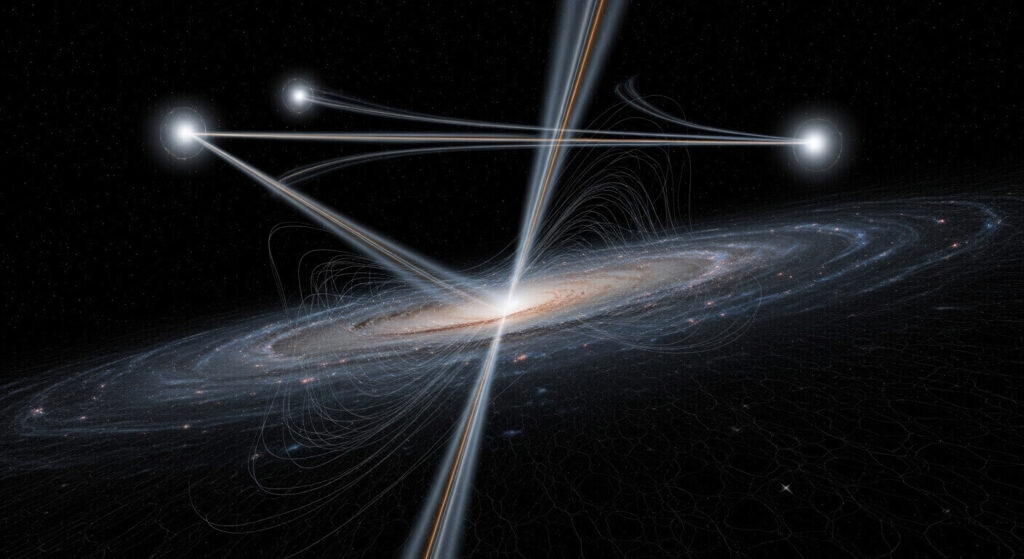
The recent study focused on a *pair* of pulsars, specifically J1640224 and J1713+0747. The logic is simple but brilliant:
- If one pulsar’s signal is delayed, it could be a glitch.
- But if *two* separate pulsars, in the same general area of the sky, *both* show the *exact same* timing anomaly, it cannot be a coincidence.
This “common-mode signal” is the smoking gun. It proves that both pulsar signals were affected by the same, massive, external object that is gravitationally warping the space between them and us. This is exactly what the data showed: a slow, persistent “drag” on the timing of both pulsars, pointing to a single, unseen source of immense gravity.
A Dark Clump 6 Times More Massive Than a Supermassive Black Hole
By measuring the precise nature of the timing delay, the astronomers could calculate the properties of the object causing it. The results were staggering.
Putting the Sheer Scale into Perspective
Here are the numbers that are shaking up the astronomical community:
- The Mass: The dark clump is estimated to have a mass of approximately 24 million solar masses. That is 24,000,000 times the mass of our sun.
- The Comparison: The supermassive black hole at the center of our own Milky Way, Sagittarius A*, is about 4 million solar masses. This newly found “dark clump” is six times more massive than that.
- The Location: This object is located only 2,300 light-years from our solar system. In galactic terms, this is not just in our backyard; it’s on our doorstep. (Our galaxy is 100,000 light-years across).
This combination of extreme mass and extreme proximity is what makes this finding so revolutionary. It’s an invisible giant that has been hiding in plain sight.
Identifying the 24 Million Solar Mass “Dark Clump”
The first question anyone would ask is: “If it’s that massive, why isn’t it just a giant black hole?” This is where the evidence becomes even more compelling.
Ruling Out a Black Hole
An object of 24 million solar masses would be classified as a supermassive black hole (or at least a very large intermediate-mass black hole). A black hole of this size is not subtle. It would be a violent, messy neighbor.
- No Accretion Signs: Black holes are defined by their intense gravity, which pulls in surrounding gas and dust. As this material spirals in, it heats up to millions of degrees and releases incredible amounts of energy in the form of X-rays and radio waves. We see *none* of this. The area is eerily quiet.
- No Lensing: A “point-like” mass like a black hole would cause intense, specific gravitational lensing of stars behind it. The observed effects are more consistent with a “diffuse” mass spread over a wider area.
Ruling Out Normal Matter
Could it be a huge cloud of normal matter (gas, dust, or dead stars) that we just can’t see?
Absolutely not. 24 million solar masses of *anything*—even cold hydrogen gas or millions of brown dwarfs—would be blindingly obvious. It would block starlight, emit infrared radiation, or long since have collapsed under its own gravity to form billions of new stars. The sky in that direction is simply not disturbed in that way.
The Last Possibility: A Dark Matter Sub-Halo
After ruling out normal matter and black holes, only one candidate remains: a dark matter sub-halo. This object fits all the criteria:
- It is massive enough to cause the observed pulsar delays.
- It is “dark,” meaning it doesn’t interact with light, which is why we see no X-rays, radio waves, or light from it.
- It interacts only through gravity, which is exactly what the pulsars are detecting.
This appears to be the first-ever direct confirmation that the invisible “lumps” predicted by dark matter theory are real, and they are lurking in our galaxy.
Implications of This Massive Dark Matter Finding
This discovery is more than just a cosmic curiosity; it has profound implications for our understanding of the universe.
- First Direct Proof of Sub-Halos: It moves dark matter sub-halos from the realm of theory to the realm of observation. This is a massive victory for the Lambda-CDM model of cosmology.
- A New Map of the Universe: This technique proves that pulsar timing is a powerful new tool for mapping the “dark” scaffolding of our galaxy. We may soon be able to find *more* of these objects, creating a true map of the invisible universe around us.
- A Cosmological Puzzle: While the finding confirms the *existence* of sub-halos, its *size* and *location* are a new puzzle. A sub-halo this massive, this close to the galactic disk, is somewhat surprising. It may force theorists to refine their models of how dark matter clumps together and how galaxies are built.
We have, in essence, just discovered a new “sense” for perceiving the universe. For the first time, we are not just looking at the cosmos; we are feeling its invisible contours through the precise rhythm of distant pulsar clocks. What we’ve found is a giant, dark, and silent neighbor we never knew we had.
Frequently Asked Questions
Q: What is a dark matter sub-halo?
A: A dark matter sub-halo is a dense, concentrated “clump” of dark matter that exists within a larger “halo” of dark matter surrounding a galaxy. Cosmological models predict that large galaxies like the Milky Way should be surrounded by thousands of these smaller, invisible sub-halos, which are the leftover “building blocks” of galaxy formation.
Q: How is this “dark clump” different from a supermassive black hole?
A: A black hole is a “point-like” object with all its mass concentrated at a singularity. This dark clump is “diffuse,” meaning its 24 million solar masses are spread out over a large area. A black hole would violently accrete gas and dust, releasing bright X-rays and radio waves. This dark clump is completely silent and invisible, interacting only via gravity.
Q: Why haven’t we found this 24 million solar mass object before?
A: Because it is completely invisible and doesn’t interact with light. We could only find it by sensing its gravity. This required the extreme precision of pulsar timing, a technique that has only recently become sensitive enough to detect such an object. We weren’t “looking” for it; we “felt” its gravitational presence.
Q: Is this massive dark clump dangerous to Earth?
A: No. While 2,300 light-years is very close by cosmic standards, it is still incredibly far away (over 13 quadrillion miles). This object has likely been in its current location for billions of years, and its gravitational influence is stable and already accounted for in the overall motion of our local stars. It poses no threat to our solar system.