Can the James Webb Telescope see black holes? You might be surprised to learn how JWST is revolutionizing our understanding of these cosmic monsters, not by seeing the unseeable, but by revealing the chaotic world that surrounds them.
Ever since I was a kid, staring up at the night sky, the idea of black holes completely captivated me. These points of infinite density where gravity is so strong that not even light can escape—it’s the stuff of science fiction, right? For decades, they were purely theoretical. But now, we’re living in a golden age of astronomy where we’re not just proving they exist, but we’re actually taking their pictures. But how do you photograph something that’s invisible? And what role does the incredible James Webb Space Telescope play in this cosmic detective story? It’s a fascinating journey, so let’s dive in! 😊
Table of Contents 📜
- How to Photograph a Ghost: The Event Horizon Telescope’s Challenge
- Our Galaxy’s Heart: The Blurry Beast, Sagittarius A*
- Enter James Webb: A New Eye on the Black Hole’s Universe
- EHT + JWST: The Ultimate Black Hole Science Team
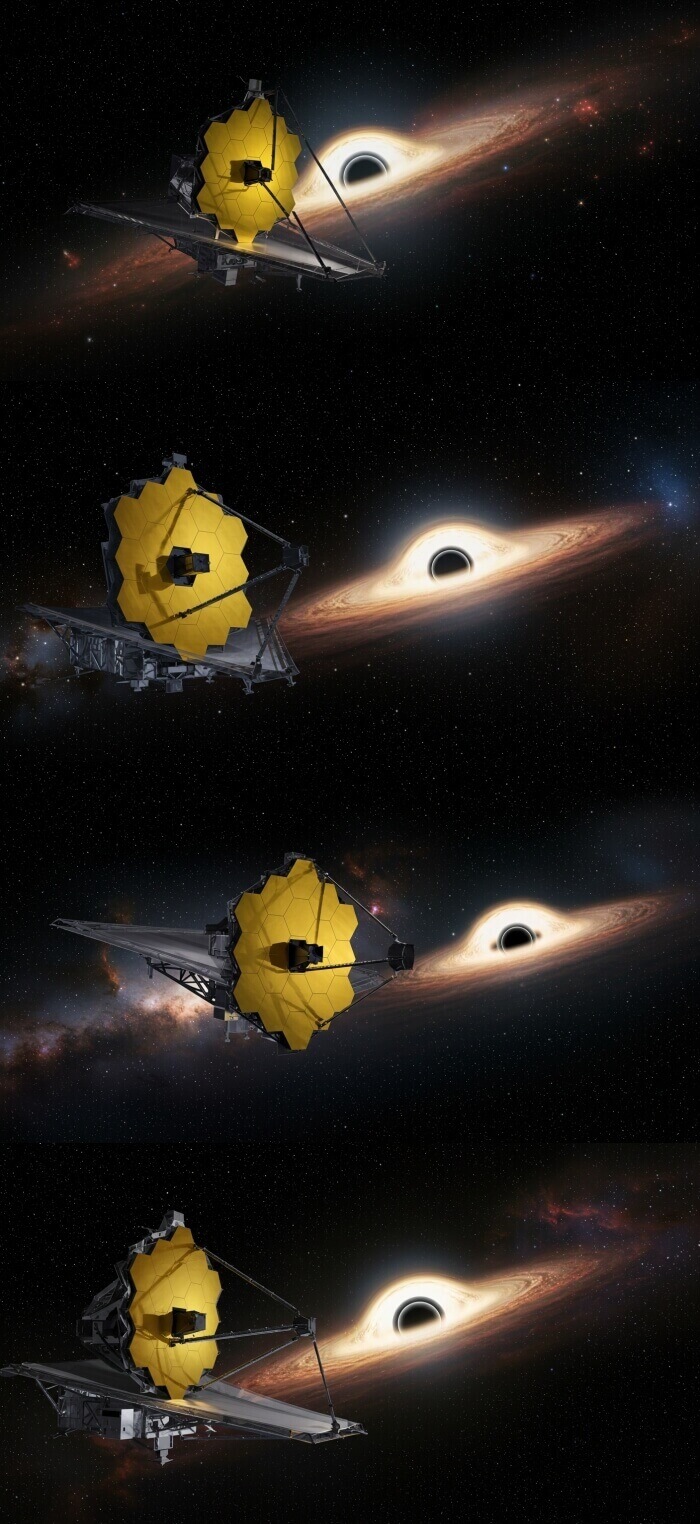
How to Photograph a Ghost: The Event Horizon Telescope’s Challenge 🤔
First off, let’s be clear: a black hole itself is just a point—a singularity. It has no size. So when we talk about “photographing” a black hole, what we’re really talking about is capturing its shadow against the brilliant backdrop of superheated gas and dust that swirls around it. This boundary, the point of no return, is called the event horizon.
As material gets pulled in by the black hole’s immense gravity, it forms a spinning disk called an accretion disk. The friction in this disk heats the material to billions of degrees, causing it to glow brightly. The light from this disk is so powerfully bent by the black hole’s gravity that it appears to us as a “photon ring” around a dark central shadow. This is the image the Event Horizon Telescope (EHT) collaboration set out to capture.
💡 Just How Hard Is It?
Capturing the image of our galaxy’s black hole, Sagittarius A*, is equivalent to trying to photograph a donut sitting on the surface of the moon from Earth. To do this, the EHT created a virtual telescope the size of our entire planet by linking radio telescopes from the North Pole to the South Pole!
It’s an incredible feat of engineering and collaboration. Using this planet-sized array, they first gave us that iconic image of the M87 galaxy’s black hole in 2019, and then, in 2022, the one at the center of our own Milky Way.
Our Galaxy’s Heart: The Blurry Beast, Sagittarius A* 🌌
You might think imaging our own galaxy’s black hole would be easier than M87’s, which is 55 million light-years away. But it was actually much harder. While M87’s black hole is a behemoth at 6.5 billion times the Sun’s mass, our Sagittarius A* (Sgr A*) is a comparatively smaller 4 million solar masses.
Because it’s smaller, the gas in its accretion disk orbits incredibly fast—completing a lap in mere minutes, compared to the days or weeks it takes for material around M87. This is like trying to take a long-exposure photo of a spinning top. The image blurs. The scientists had to develop sophisticated new algorithms to “average out” the image from the rapidly changing data. That’s why the Sgr A* image appears a bit less sharp, with three bright spots instead of one concentrated region like in M87’s image.
⚠️ A Shocking Tilt!
One of the most stunning discoveries from the Sgr A* image is that the black hole’s axis of rotation is tilted by about 60 degrees relative to the plane of the Milky Way. It’s basically lying on its side! This is a huge surprise and might be evidence of a past, violent merger with another galaxy.
Enter James Webb: A New Eye on the Black Hole’s Universe 🔭
So, where does the James Webb Space Telescope fit in? It’s important to understand that JWST cannot take a picture of a black hole’s shadow like the EHT can. The EHT uses radio waves and a planet-sized array to get the necessary resolution. JWST is a single (though massive) telescope that observes in infrared light.
But that’s its superpower. The center of our galaxy is shrouded in thick clouds of cosmic dust, which blocks visible light. It’s like trying to see through dense fog. Infrared light, however, can pierce through this dust. JWST gives us an unprecedentedly clear view of the *environment* immediately surrounding the black hole.
What JWST Actually Sees 📝
- Individual Stars: JWST can resolve the individual stars orbiting Sgr A*, tracking their motion to help us precisely measure the black hole’s mass.
- Gas and Dust Structures: It reveals the intricate structures of gas clouds being pulled towards the black hole, showing us how it “feeds.”
- Star Formation: It has captured stunning images of star-forming regions near the galactic center, helping us understand how stars can be born in such a turbulent environment.
Think of it this way: The EHT showed us the portrait of the monster. Now, JWST is showing us the monster’s entire lair in breathtaking detail.
EHT + JWST: The Ultimate Black Hole Science Team 🤝
This is where modern astronomy gets truly exciting. These two incredible observatories are not competitors; they are partners. Their different capabilities create a more complete picture than either could alone.
| Observatory | Primary Target | Method |
|---|---|---|
| Event Horizon Telescope (EHT) | Black Hole Shadow & Photon Ring | Planet-sized array of Radio Telescopes |
| James Webb (JWST) | Surrounding Stars, Gas, and Dust | High-resolution Infrared Imaging |
By combining the EHT’s data on the event horizon with JWST’s data on the surrounding environment, scientists can build much more accurate models of how black holes affect their galaxies. We can finally start to answer the big questions: How do these supermassive black holes grow? How do they launch powerful jets of energy? And how did they shape the evolution of entire galaxies, including our own?
💡
Key Takeaways: Webb & Black Holes
The Right Tool for the Job:EHT images the “shadow” of a black hole using radio waves, while JWST images the surrounding “environment” in infrared.
Seeing Through Dust: JWST’s infrared vision is crucial for studying the center of our dusty Milky Way galaxy, revealing stars and gas clouds hidden from other telescopes.
Synergy is Key:
EHT (The What) + JWST (The Why/How) = Fuller Understanding
A New Era: Combining data from both observatories allows for the most complete models of black hole behavior and their impact on galaxy evolution.
This powerful combination is unlocking secrets from our galactic core to the early universe.
Frequently Asked Questions ❓
Q: So, will JWST ever take a picture of a black hole’s shadow like the EHT?
A: No, that’s not what it was designed for. JWST is an infrared telescope, and it doesn’t have the planet-wide size needed to achieve the same kind of resolution as the EHT. It’s designed to see the bigger picture around the black hole with incredible sensitivity and clarity.
Q: Why did the Sgr A* image look so much blurrier than the M87 image?
A: Because the material around Sgr A* is moving so much faster! It orbits in minutes, while material around the much larger M87 black hole takes days. It’s like trying to photograph a race car versus a parked truck—the fast-moving target is harder to capture sharply.
Q: Can the EHT or JWST take a picture of the black hole in the Andromeda galaxy?
A: Not with current technology, unfortunately. Even though Andromeda’s black hole is much more massive than ours (about 100 million solar masses), the galaxy is about 100 times farther away from us than our own galactic center. This makes its apparent size in our sky too small for even the EHT to resolve right now.
It’s truly a privilege to be alive at a time when we can witness these cosmic mysteries being unveiled. From the mind-bending physics at the event horizon to the beautiful, chaotic dance of stars and gas in the galactic center, every new image brings more questions and deeper wonder. What other secrets are hiding in the dark? With the combined power of JWST and the EHT, I have a feeling we’re just getting started. What do you think they’ll find next? Let me know in the comments! 😊