Wondering where BepiColombo is now and when it reaches Mercury? See the 2026 arrival timeline, MPO and Mio roles, nine flybys, and the 2027 science phase.
BepiColombo is a joint Mercury exploration mission led by the European Space Agency (ESA) in close cooperation with the Japan Aerospace Exploration Agency (JAXA).
Launched on 20 October 2018, the spacecraft has spent nearly eight years travelling through the inner Solar System. In September 2026, the Mercury Transfer Module (MTM), which had provided power and propulsion during the cruise, successfully separated from the two science orbiters.
The next major milestone is 21 November 2026. On that date, ESA’s Mercury Planetary Orbiter (MPO) and JAXA’s Mercury Magnetospheric Orbiter (Mio), still connected as one spacecraft stack, are scheduled to be captured into orbit around Mercury.
The two orbiters are then expected to separate on 9–10 December 2026, with the mission’s main science phase beginning in April 2027, according to ESA’s latest BepiColombo arrival update.
Table of Contents
BepiColombo at a Glance
Two ideas make the entire mission much easier to understand:
- Getting to Mercury is not mainly a distance problem. The difficult part is losing enough orbital energy to arrive slowly enough to be captured by Mercury’s gravity.
- BepiColombo uses two science orbiters. MPO and Mio will observe Mercury and its space environment from different locations at the same time.
The second point is particularly important. ESA describes BepiColombo as the first mission to orbit Mercury with two spacecraft simultaneously. ESA explains the two-orbiter mission here
| Mission milestone | Current plan |
|---|---|
| Mission | BepiColombo |
| Destination | Mercury |
| Agencies | ESA and JAXA |
| Launch | 20 October 2018 |
| Science orbiters | MPO and Mio |
| Planetary flybys | 9 |
| Final Mercury flyby | 8 January 2025 |
| MTM separation | 3 September 2026 |
| Mercury orbit capture | 21 November 2026 |
| MPO–Mio separation | 9–10 December 2026 |
| Science phase begins | 6 April 2027 |
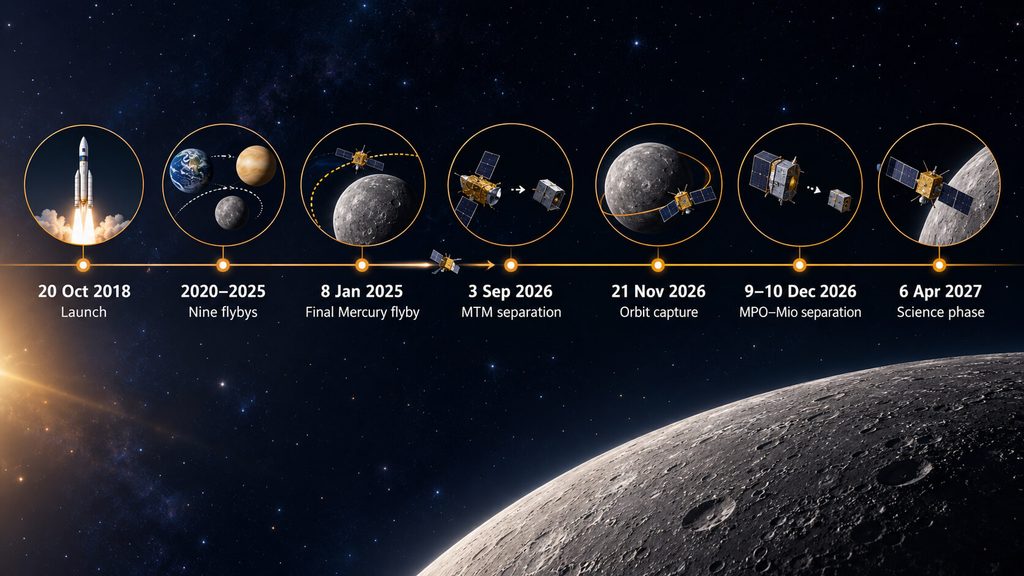
The updated sequence is shown in ESA’s official BepiColombo arrival timeline. ESA also notes that exact dates may still change for operational reasons.
It is useful to think of “arrival at Mercury” as a process rather than a single moment:
- Mercury orbit capture
- MPO and Mio separation
- Final orbit adjustment and commissioning
- Start of full science operations
That distinction explains why different pages may refer to November 2026, December 2026 or April 2027 when discussing BepiColombo’s arrival.
What Is BepiColombo?
BepiColombo is best understood not as a single spacecraft, but as an international Mercury exploration mission built around two scientific orbiters.
The mission consists of:
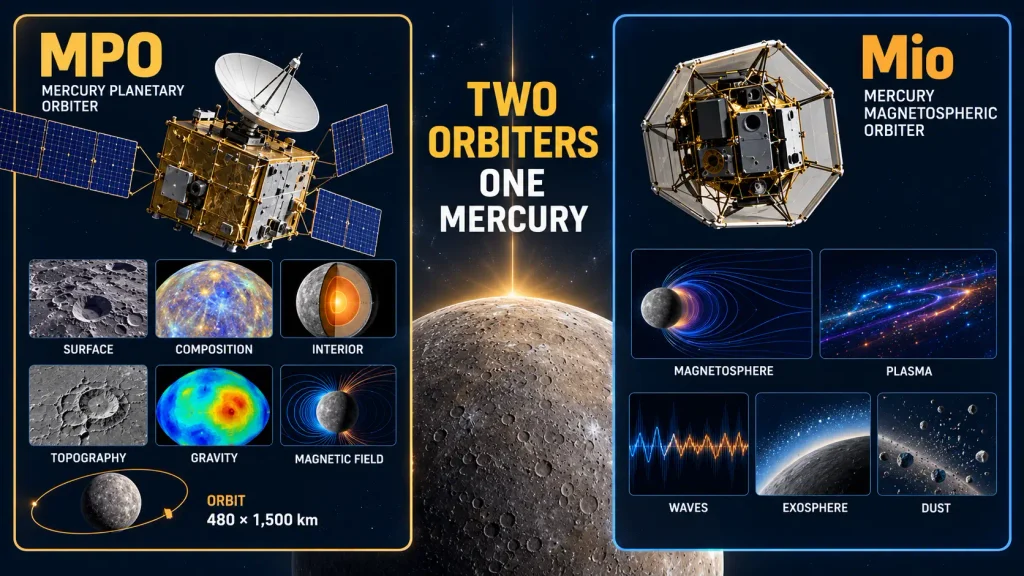
- ESA’s Mercury Planetary Orbiter (MPO), which focuses primarily on Mercury itself
- JAXA’s Mercury Magnetospheric Orbiter (Mio), which focuses primarily on Mercury’s magnetic and plasma environment
ESA describes BepiColombo as its first mission to Mercury and confirms that the mission consists of these two science spacecraft. ESA’s official “What is BepiColombo?” overview
Why Are ESA and JAXA Exploring Mercury Together?
Mercury cannot be fully understood by studying its surface alone.
Scientists also need to examine:
- surface geology and chemistry
- the planet’s unusually large metallic core
- its internal magnetic field
- its magnetosphere
- the solar wind
- Mercury’s extremely thin exosphere
MPO and Mio divide these jobs between them.
Comparison of BepiColombo’s two science orbiters and their primary research targets at Mercury.
| Orbiter | Main focus |
|---|---|
| MPO | Surface, composition and interior, plus topography, gravity and Mercury’s magnetic field |
| Mio | Magnetosphere and plasma environment, plus electromagnetic waves, exosphere and dust |
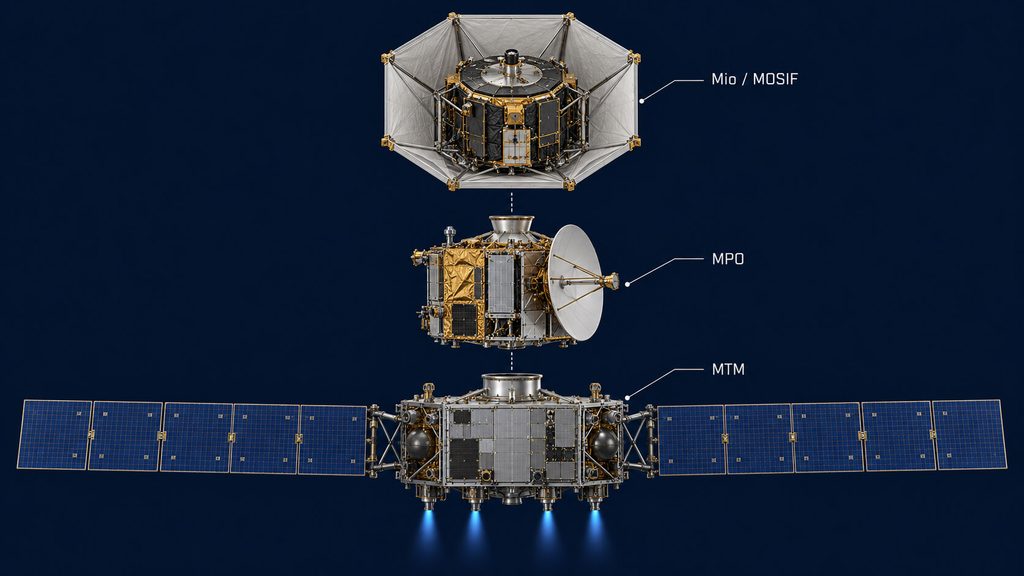
ESA’s Mercury Planetary Orbiter overview explains MPO’s planetary science role, while JAXA’s Mio mission overview describes the magnetospheric measurements performed by the Japanese orbiter.
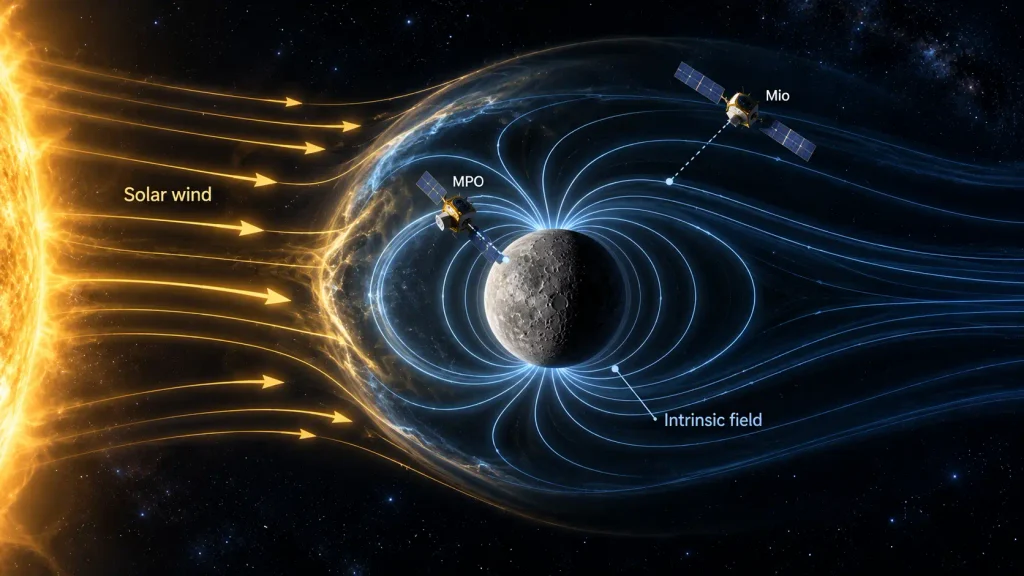
The advantage of using two spacecraft becomes clear when Mercury’s magnetic environment changes.
With measurements from only one location, it can be difficult to determine whether a change originated inside Mercury or was caused by changes in the solar wind.
JAXA explains that simultaneous measurements from MPO and Mio will help scientists separate Mercury’s intrinsic magnetic field from disturbances caused by the solar wind. JAXA explains the advantage of simultaneous observations here
Where Did the Name BepiColombo Come From?
The mission is named after Italian mathematician and engineer Giuseppe “Bepi” Colombo (1920–1984).
Colombo studied Mercury’s unusual rotational behaviour and proposed a trajectory that would allow NASA’s Mariner 10 spacecraft to use a Venus gravity assist and encounter Mercury several times rather than only once.
ESA credits Colombo with the idea that enabled Mariner 10 to make multiple Mercury flybys. ESA’s explanation of the BepiColombo name and Mariner 10 connection
The concept was confirmed by NASA’s Jet Propulsion Laboratory, and Mariner 10 ultimately flew past Mercury three times in 1974–1975.
Modern missions such as MESSENGER and BepiColombo take the same basic principle much further, using repeated planetary encounters to change orbital energy and make Mercury orbit possible. ESA explains this history in its detailed guide to why reaching Mercury takes so long.
For a broader introduction to the mission and its 2026 arrival, see:
BepiColombo 2026 Mission Guide
Where Is BepiColombo Now?
As of October 2026, BepiColombo has completed its long interplanetary cruise and is in the final Mercury arrival phase.
MPO and Mio remain attached to one another, while MPO now takes responsibility for the final approach and trajectory control ahead of Mercury orbit insertion.
ESA’s latest mission update confirms that the arrival phase began when the Mercury Transfer Module separated on 3 September 2026. Follow ESA’s current BepiColombo arrival updates
One point often causes confusion.
BepiColombo had already completed its sixth and final Mercury flyby on 8 January 2025, but a flyby is not the same as entering orbit.
A flyby allows the spacecraft to pass close to Mercury and use the planet’s gravity to change its trajectory and orbital energy. Orbit insertion means the spacecraft finally arrives slowly enough to remain gravitationally bound to Mercury.
ESA lists all six Mercury encounters in its updated BepiColombo mission timeline.
Difference between a Mercury flyby and Mercury orbit capture during the BepiColombo mission.
| Event | What it means |
|---|---|
| Mercury flyby | The spacecraft passes Mercury and uses the encounter to reshape its orbit. |
| Mercury orbit capture | The spacecraft becomes gravitationally bound to Mercury and begins orbiting the planet. |
So although BepiColombo has already flown close to Mercury six times, those encounters were part of the braking strategy needed for the final arrival.
Why Was the September 2026 MTM Separation So Important?
The Mercury Transfer Module was far more than a structural connector.
It supplied the power and solar-electric propulsion that carried the two science orbiters across the inner Solar System.
According to ESA, BepiColombo travelled approximately 9.9 billion kilometres during its eight-year journey and completed nine planetary flybys before MTM separation. ESA’s report on the successful MTM separation
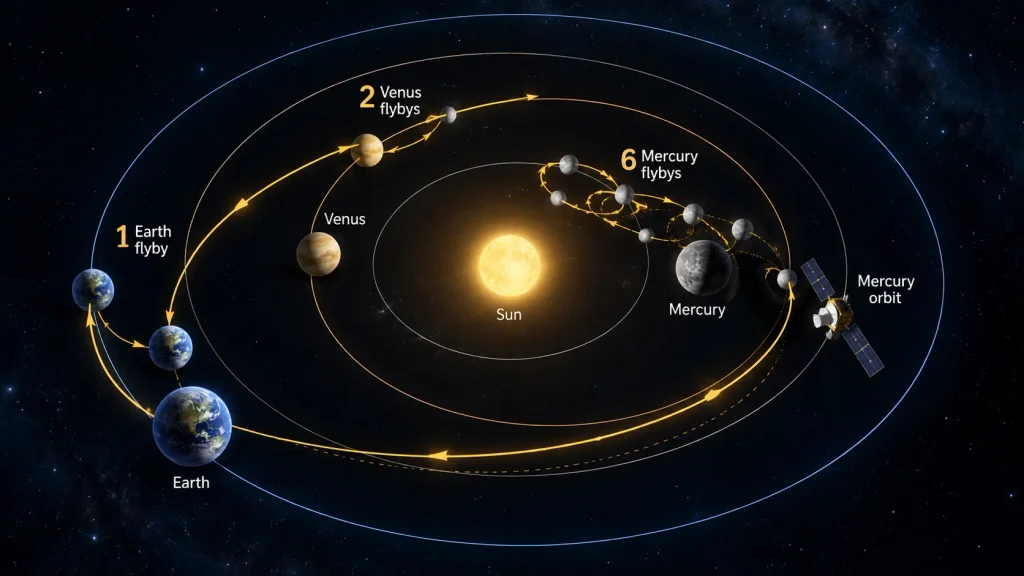
The nine flybys consisted of:
- 1 Earth flyby
- 2 Venus flybys
- 6 Mercury flybys
MTM used solar-electric propulsion, in which electrical power is used to ionise xenon and accelerate the ions through thrusters.
Unlike a chemical rocket, which provides a large amount of thrust for a relatively short period, solar-electric propulsion provides a much smaller push over long periods while using far less propellant.
ESA explains that this high-efficiency propulsion system was one of the technologies that made BepiColombo’s complex journey possible. Read ESA’s MTM and solar-electric propulsion explanation
MTM successfully separated on 3 September 2026.
From that point, BepiColombo moved from its long cruise phase into the final sequence of operations leading to Mercury orbit.
What Is MPO Doing During the Final Approach?
After MTM separation, MPO became responsible for controlling the remaining spacecraft stack, including the still-attached Mio orbiter.
On 24 September 2026, MPO used its axial thrusters for the first time in this new configuration.
ESA reported that:
- the burn lasted 8 minutes 42 seconds
- it produced a velocity change of 11.4 m/s
- it was the first planned trajectory correction after MTM separation
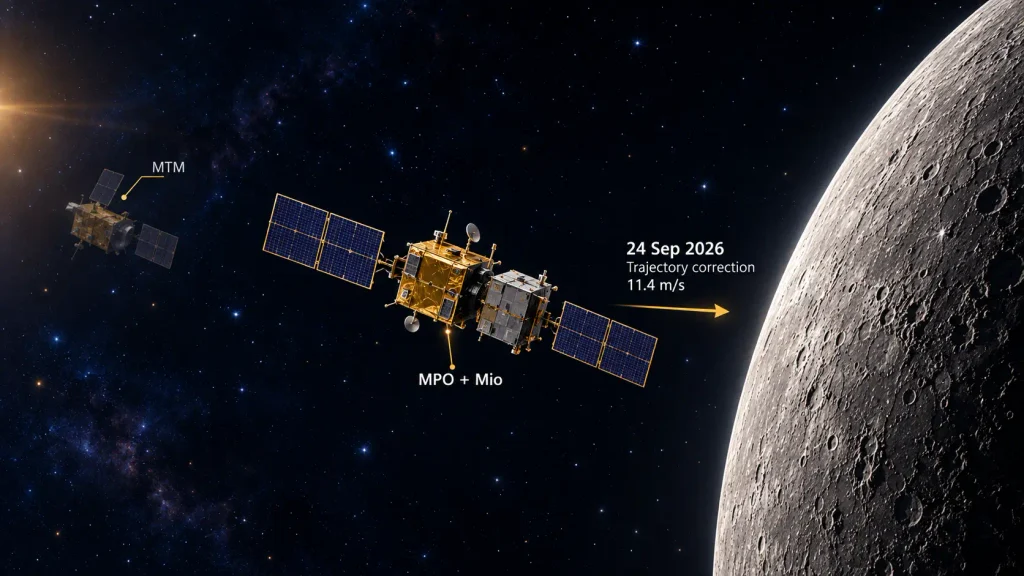
The details are available in ESA’s 28 September arrival update.
A change of 11.4 m/s may sound small, but small velocity differences can produce very large positional differences after a spacecraft travels for days or weeks.
ESA has therefore planned additional correction opportunities to ensure BepiColombo reaches Mercury at the required position and velocity for orbit insertion.
When Will BepiColombo Enter Orbit Around Mercury?
The key date is 21 November 2026.
MPO and Mio, still stacked together, are scheduled to be captured into a polar orbit around Mercury on that date, according to ESA’s official arrival timeline.
In simple terms, this is the moment when BepiColombo stops merely passing through Mercury’s neighbourhood and becomes gravitationally bound to the planet.
However, orbit capture is not the end of the arrival sequence.
The remaining process is:
- Capture the combined MPO–Mio spacecraft into Mercury orbit
- Separate Mio
- Release Mio’s protective sunshield structure
- Lower MPO into its own operational orbit
- Commission the spacecraft and instruments
- Begin full science operations
This is why 21 November 2026 is better understood as the beginning of BepiColombo’s orbital mission, not the completion of the entire arrival process.
BepiColombo Timeline: 2026–2027
- 20 October 2018 — Launch
BepiColombo launched aboard an Ariane 5 from Europe’s Spaceport in French Guiana. ESA records the launch date in its official mission overview. - 2020–2025 — Nine planetary flybys
The mission completed one Earth flyby, two Venus flybys and six Mercury flybys. ESA lists all nine encounters here. - 8 January 2025 — Final Mercury flyby
BepiColombo completed its sixth and final Mercury flyby. - 3 September 2026 — MTM separation
The Mercury Transfer Module completed its job and separated successfully. ESA’s MTM separation report - 21 November 2026 — Mercury orbit capture
MPO and Mio are scheduled to enter Mercury orbit while still connected. - 9–10 December 2026 — Mio separation
MPO will release Mio into its final elliptical polar orbit. - 16 December 2026 — MOSIF separation
The protective sunshield structure used for Mio will be released, and MPO will continue towards its own science orbit. - 10 March 2027 — MPO reaches final orbit
ESA’s current arrival timeline places MPO in its final science orbit on this date. - 6 April 2027 — Science phase begins
Full science operations are currently scheduled to begin.
The final four dates come directly from ESA’s July 2026 arrival timeline, which notes that exact dates may change for operational reasons.
Why Do Different Sources Give Different “Arrival” Dates?
This is one of the easiest parts of the mission to misunderstand.
Some material refers broadly to BepiColombo arriving at Mercury in late 2026, while more detailed operational updates identify 21 November as orbit capture and 9–10 December as the separation of the two science orbiters.
These dates are not necessarily contradictory.
They describe different parts of the same arrival sequence:
Key BepiColombo arrival milestones from Mercury orbit capture to the start of full science operations.
| Date | What happens |
|---|---|
| 21 November 2026 | Mercury orbit capture |
| 9–10 December 2026 | MPO and Mio separate |
| 16 December 2026 | MOSIF sunshield released |
| 10 March 2027 | MPO reaches final orbit |
| 6 April 2027 | Full science phase begins |
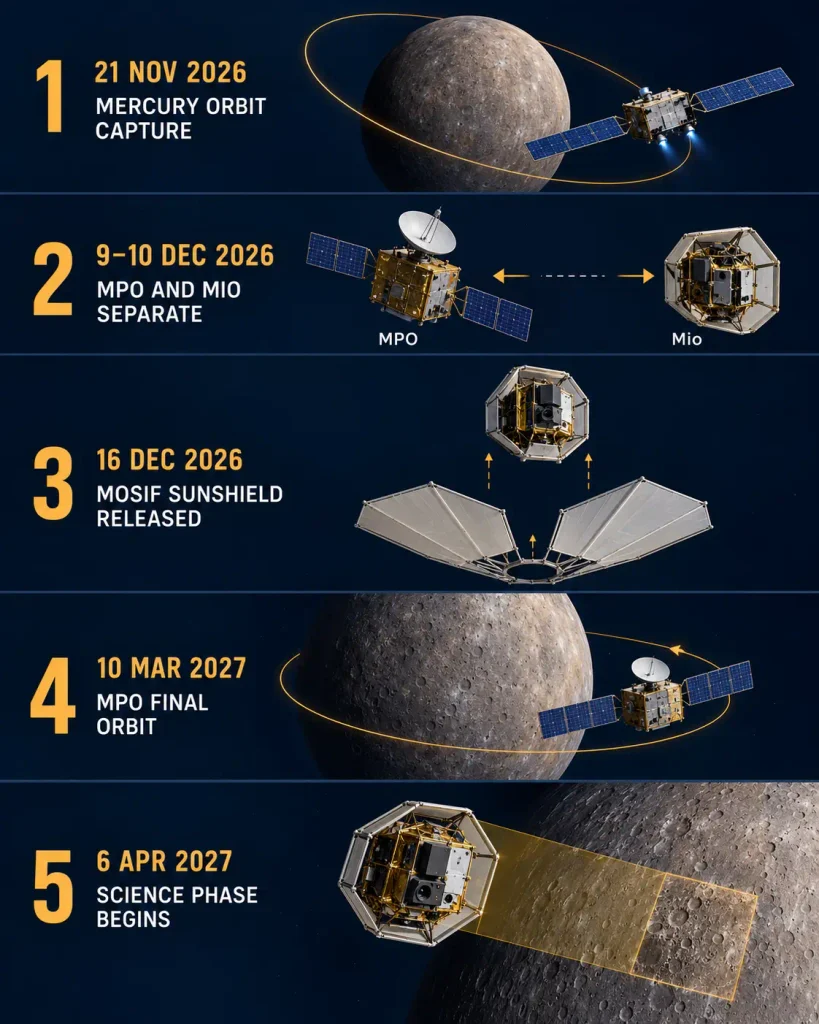
For that reason, it is more accurate to describe BepiColombo’s arrival as a multi-stage process rather than a single date.
Why Did BepiColombo Take Nearly Eight Years to Reach Mercury?
Mercury is not difficult to reach because it is extremely far away.
The real challenge is slowing down enough to enter orbit once the spacecraft gets there.
A spacecraft travelling from Earth towards the Sun falls deeper into the Sun’s gravitational field and gains speed.
If it reaches Mercury moving too quickly relative to the planet, Mercury’s comparatively weak gravity cannot capture it and the spacecraft simply flies past.
ESA explains this problem in detail in Why does it take so long to get to Mercury?.
A useful analogy is driving towards a destination without adequate brakes.
Reaching the location is only part of the problem. You must also be able to reduce your speed enough to stop where you intended.
For BepiColombo, the challenge was not simply:
“How quickly can we reach Mercury?”
It was:
“How can we remove enough orbital energy to arrive at Mercury slowly enough to stay there?”
Why Is Mercury So Difficult to Orbit?
Travelling from Earth towards Mercury is, in orbital terms, like moving downhill towards the Sun.
As BepiColombo moves closer to the Sun, the spacecraft tends to accelerate.
Mercury itself also travels very quickly around the Sun.
ESA compares the challenge of entering Mercury orbit to falling from an enormous cliff and trying to land gently on a moving target. ESA’s explanation of the orbital-energy problem
Using chemical rocket engines alone to remove the required orbital energy would demand an enormous amount of propellant.
More propellant would increase spacecraft mass, which would in turn require even more launch and propulsion capability.
Instead, BepiColombo combines efficient propulsion with repeated gravity assists.
Why Did BepiColombo Need Nine Planetary Flybys?
BepiColombo did not travel from Earth to Mercury in a simple straight line.
Its route used:
- 1 Earth flyby
- 2 Venus flybys
- 6 Mercury flybys
During a carefully planned gravity assist, the spacecraft exchanges energy and momentum with a planet, changing the shape and speed of its solar orbit without needing to achieve the entire change with onboard propellant.
ESA explains that these nine flybys allowed BepiColombo to progressively shed enough orbital energy to approach Mercury at the correct speed. See ESA’s explanation of the nine-flyby strategy
That is also why BepiColombo passed Mercury six times before actually entering orbit.
Those encounters were not failed arrival attempts.
They were part of the braking strategy.
Key Point
For a Mercury orbiter, distance is not the main difficulty.
The difficult part is arriving slowly enough for Mercury’s gravity to capture the spacecraft.
How Many Spacecraft Are in BepiColombo?
The main science mission uses two orbiters: MPO and Mio.
During the interplanetary cruise, several components were stacked together, including the Mercury Transfer Module and the protective structure surrounding Mio.
After the 2026 arrival sequence is complete, the two science spacecraft will operate independently in different Mercury orbits.
ESA’s BepiColombo mission overview explains this two-orbiter architecture.
The broader history of Mercury exploration helps put this into perspective.
Comparison of the major Mercury exploration missions and their significance in the history of planetary exploration.
| Mission | Importance in Mercury exploration |
|---|---|
| Mariner 10 | First spacecraft to explore Mercury at close range |
| MESSENGER | First spacecraft to orbit Mercury |
| BepiColombo | First mission designed to operate two science spacecraft in Mercury orbit simultaneously |
What Does ESA’s Mercury Planetary Orbiter (MPO) Study?
MPO is primarily designed to study Mercury as a planet.
ESA states that MPO will operate in a roughly 480 × 1,500 km polar orbit with a period of about 2.3 hours. ESA Mercury Planetary Orbiter technical overview
Its science package includes 11 experiments or instrument suites.
Examples include:
- BELA — measures topography and surface morphology
- MERTIS — studies mineralogy and thermal properties
- SIMBIO-SYS — provides imaging and spectroscopic observations
- instruments for magnetic-field measurements
- X-ray, gamma-ray and neutron observations
- exosphere measurements
- radio-science and precision-orbit experiments
ESA provides the full payload description on its MPO science instruments page.
What Does JAXA’s Mercury Magnetospheric Orbiter, Mio, Study?
Mio concentrates on Mercury’s magnetosphere and the surrounding space environment.
Its instruments include systems for measuring:
- magnetic fields
- plasma particles
- plasma waves
- sodium in Mercury’s exosphere
- interplanetary dust
JAXA outlines these instruments and the mission’s scientific objectives on the official Mio mission page.
Mio must operate in one of the harshest thermal environments encountered by a planetary spacecraft.
Mercury is close to the Sun, so the orbiter must cope not only with intense solar radiation but also with heat radiated from Mercury’s surface.
Why Does BepiColombo Need Two Orbiters?
The most important reason is that two spacecraft can distinguish changes caused by Mercury itself from changes caused by the solar wind.
Mercury has a global magnetic field generated within the planet.
At the same time, it orbits close to the Sun and is exposed to an intense, highly variable solar wind.
Measurements from a single spacecraft may not always reveal whether a change in the electromagnetic environment originated inside Mercury or arrived from the Sun.
MPO and Mio can observe different regions at the same time.
JAXA specifically highlights this as an advantage of the mission, explaining that combined MPO and Mio observations can help separate Mercury’s intrinsic magnetic field from solar-wind disturbances. JAXA’s explanation of the two-spacecraft advantage
In Simple Terms
- MPO looks more closely at Mercury itself.
- Mio focuses more strongly on Mercury’s surrounding space environment.
- Together, they provide simultaneous measurements from two locations.
This is one of the most important differences between BepiColombo and earlier Mercury missions.
It is not simply a newer spacecraft with newer instruments.
It changes the geometry of the observations by adding a second measuring point.
What Will BepiColombo Study at Mercury?
BepiColombo is not simply going to Mercury to take sharper photographs.
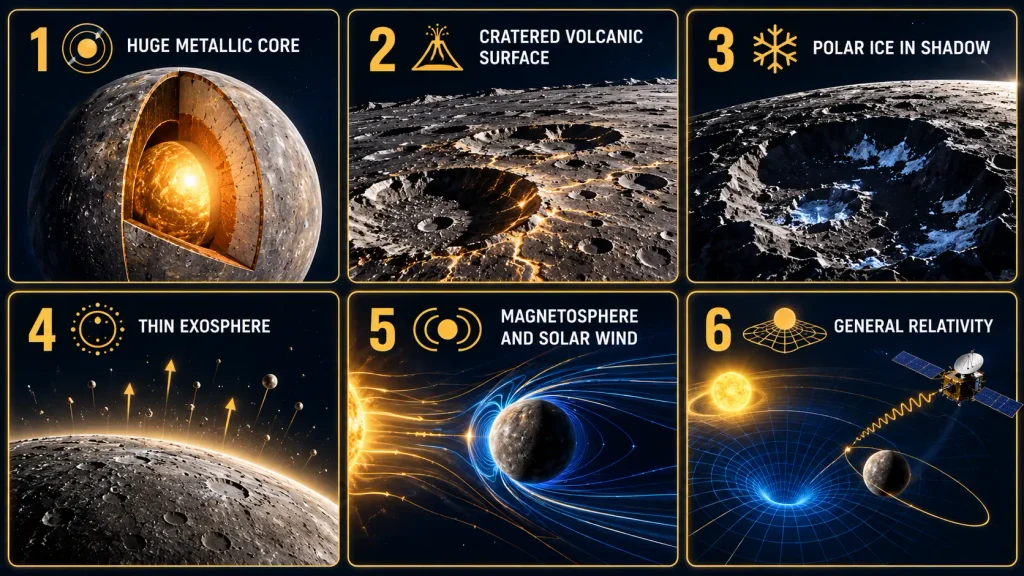
Its science programme covers the planet’s origin, interior, surface, magnetic field, exosphere, magnetosphere and even tests of general relativity.
ESA lists these topics in its official BepiColombo science themes.
The main questions include:
- How did Mercury form and evolve?
- Why does such a small planet have such a large metallic core?
- How is Mercury’s magnetic field generated?
- What shaped its surface?
- What creates and maintains its thin exosphere?
- How does the solar wind interact with its magnetosphere?
- Can precise spacecraft tracking provide new tests of Einstein’s theory of general relativity?
How Did Mercury Form and Evolve?
Mercury is the innermost rocky planet in the Solar System.
Studying its composition and geology can help scientists understand how planets formed in the hot inner region of the young Solar System.
BepiColombo will combine measurements of Mercury’s elemental and mineral composition with observations of its geology and surface structure.
ESA explains that understanding Mercury can provide broader information about the origin and evolution of planets close to their parent stars. ESA’s BepiColombo science overview
What Is Inside Mercury’s Huge Metallic Core?
One of Mercury’s most unusual characteristics is the size of its metallic core relative to the size of the planet.
Understanding why Mercury ended up with such an unusual internal structure is closely connected to understanding how the planet formed.
BepiColombo will combine measurements of:
- gravity
- rotation
- topography
- magnetic fields
to improve models of Mercury’s internal structure.
ESA includes the planet’s interior structure and composition among the mission’s central science themes. See ESA’s science objectives
Why Does Mercury Have a Magnetic Field?
Despite its small size, Mercury possesses a global magnetic field generated within the planet.
Scientists want to understand how an internal dynamo can still operate inside such a small world.
By measuring the strength, direction and spatial structure of the magnetic field, BepiColombo can provide new constraints on Mercury’s interior.
The combined observations from MPO and Mio are particularly valuable here.
What Will BepiColombo Study on Mercury’s Surface and at the Poles?
Mercury’s surface records a long history of:
- impact cratering
- volcanic activity
- tectonic deformation
- extreme space weathering
BepiColombo will study these surface processes together with deposits in Mercury’s polar regions.
Some polar craters contain areas that remain permanently shadowed despite Mercury’s proximity to the Sun.
NASA’s MESSENGER mission provided strong evidence that many of these polar deposits are dominated by water ice. NASA’s MESSENGER mission summary and discoveries
BepiColombo will build on that earlier work with a new set of complementary instruments.
How Is Mercury’s Thin Exosphere Produced?
Mercury does not have a dense atmosphere like Earth.
Instead, it has an extremely tenuous exosphere, where atoms and molecules are so sparse that they rarely collide.
Possible processes contributing material to the exosphere include:
- interaction with the solar wind
- micrometeoroid impacts
- thermal effects at the surface
BepiColombo will study the composition and variability of this exosphere and investigate how material moves between Mercury’s surface and its surrounding environment.
ESA includes the structure, composition, origin and dynamics of Mercury’s exosphere among the mission’s official scientific objectives. ESA BepiColombo science themes
How Does the Solar Wind Interact With Mercury?
Mercury orbits deep inside the solar environment, where it experiences strong and variable solar-wind conditions.
Mio will measure plasma particles, magnetic fields and electromagnetic waves to study how Mercury’s compact magnetosphere responds to this environment.
These observations may also provide useful comparisons for understanding rocky planets orbiting close to other stars.
How Can BepiColombo Test General Relativity?
BepiColombo’s science programme also includes precision tests of Einstein’s theory of general relativity.
Because Mercury orbits deep within the Sun’s gravitational field, precise measurements of a spacecraft’s orbit and radio signals can be used to compare observations with predictions from gravitational theory.
ESA explicitly lists general relativity among BepiColombo’s scientific themes. ESA’s official science-theme summary
MPO instruments and experiments such as ISA and radio-science measurements contribute to this part of the mission. See ESA’s MPO science payload description
How Is BepiColombo Different From NASA’s MESSENGER?
The clearest difference is that MESSENGER was one Mercury orbiter, while BepiColombo uses two science orbiters operating at the same time.
NASA’s MESSENGER launched in 2004 and entered Mercury orbit in March 2011.
It became the first spacecraft ever to orbit Mercury and remained in orbit for more than four years before the mission ended in April 2015. NASA’s official MESSENGER mission page
MESSENGER made major discoveries about:
- Mercury’s surface composition
- geological history
- internal magnetic field
- volatile materials
- water ice in permanently shadowed polar regions
BepiColombo is designed to extend and refine many of those investigations.
Side-by-side comparison of NASA’s MESSENGER mission and the ESA–JAXA BepiColombo mission at Mercury.
| Comparison | MESSENGER | BepiColombo |
|---|---|---|
| Agency | NASA | ESA + JAXA |
| Launch | 2004 | 2018 |
| Mercury orbit | 2011 | Planned for 2026 |
| Science orbiters | 1 | 2 |
| Observation geometry | Single spacecraft | MPO and Mio observing simultaneously |
| Major contribution | First Mercury orbiter | Detailed planetary and magnetospheric observations from two spacecraft |
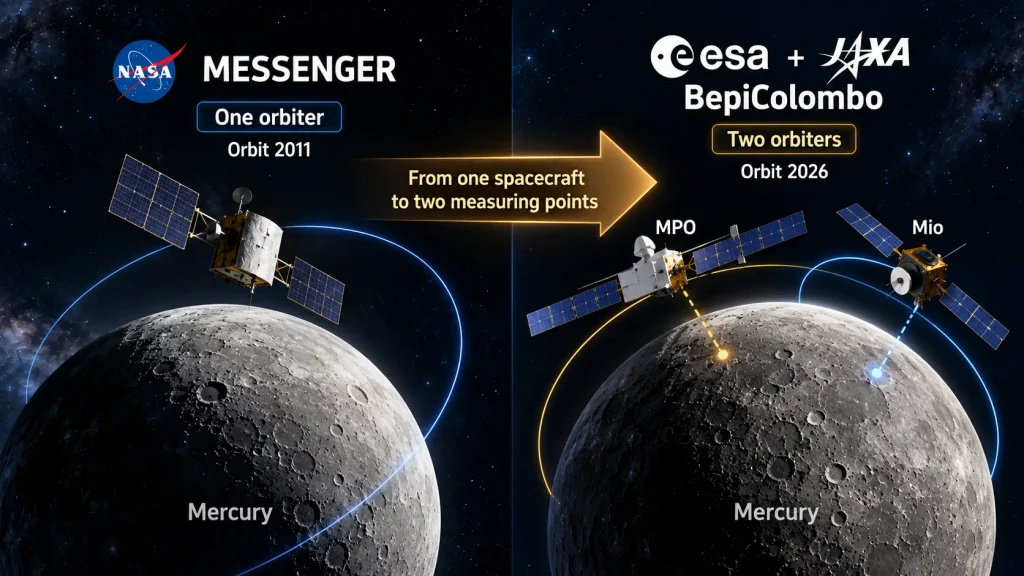
A useful way to think about the relationship is this:
MESSENGER greatly expanded our understanding of what Mercury is like. BepiColombo is designed to investigate in greater detail why Mercury has those unusual characteristics.
That is a simplification—the two missions have overlapping scientific goals—but it captures the progression well.
BepiColombo benefits from both improved instrumentation and the ability to make simultaneous observations from two different spacecraft.
BepiColombo FAQ
Is BepiColombo a NASA Mission?
No.
BepiColombo is an ESA-led mission conducted in close collaboration with JAXA.
ESA describes it as a joint European–Japanese Mercury mission comprising ESA’s MPO and JAXA’s Mio. ESA BepiColombo arrival media kit
NASA’s major Mercury missions were Mariner 10 and MESSENGER.
MESSENGER became the first spacecraft to orbit Mercury in 2011. NASA MESSENGER mission overview
When Will BepiColombo Start Full Science Operations?
The current plan is 6 April 2027.
BepiColombo will enter Mercury orbit in November 2026, but the mission cannot immediately begin full science operations.
The spacecraft must first:
- separate MPO and Mio
- place each orbiter into its intended orbit
- complete spacecraft commissioning
- check and prepare the science instruments
ESA’s current arrival timeline places the beginning of the science phase on 6 April 2027. See ESA’s updated arrival schedule
So if search results show November 2026, December 2026 and April 2027, those dates do not necessarily conflict.
Key BepiColombo dates showing the progression from Mercury orbit capture to full science operations.
| Date | Meaning |
|---|---|
| November 2026 | Mercury orbit capture |
| December 2026 | MPO and Mio separation |
| April 2027 | Full science phase begins |
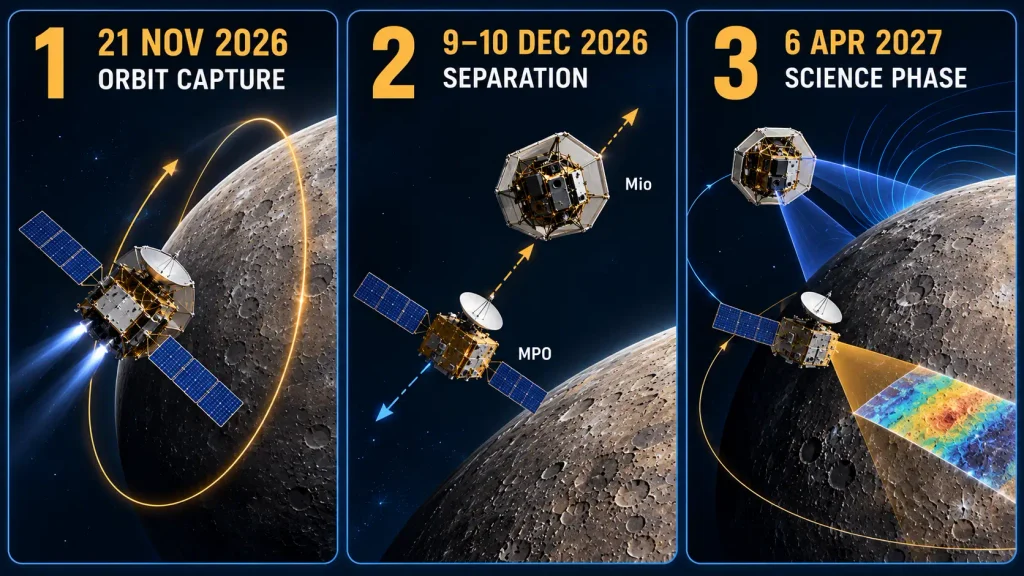
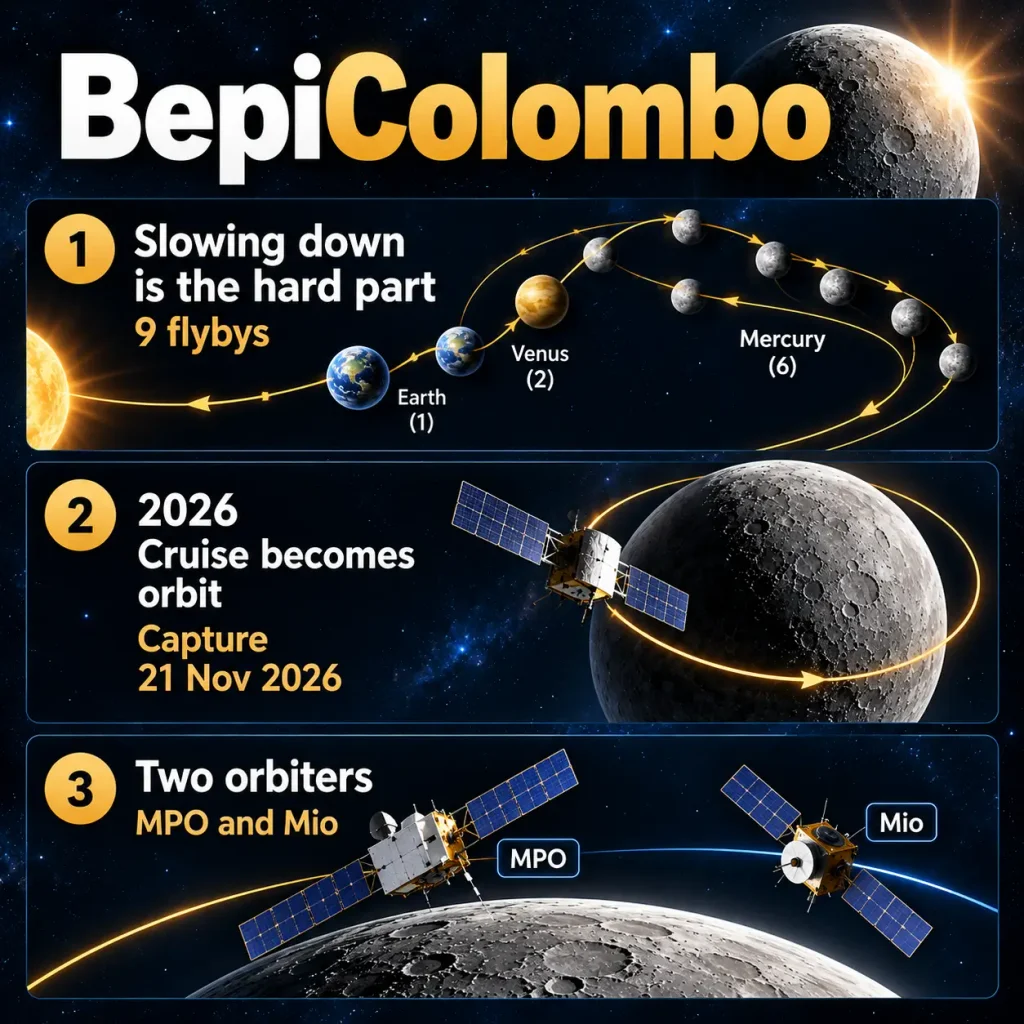
BepiColombo: The Three Things to Remember
1. The Hard Part Is Not Reaching Mercury — It Is Slowing Down
BepiColombo used solar-electric propulsion and nine planetary gravity assists to reduce its orbital energy.
Those flybys included one encounter with Earth, two with Venus and six with Mercury. ESA explains the full gravity-assist strategy here
2. 2026 Is the Year BepiColombo Moves From Cruise to Mercury Orbit
The Mercury Transfer Module separated on 3 September 2026.
The spacecraft is scheduled for Mercury orbit capture on 21 November 2026, followed by MPO–Mio separation in December.
Full science operations are scheduled to begin in April 2027. Follow ESA’s current arrival-phase updates
3. Two Orbiters Are the Mission’s Biggest Scientific Advantage
MPO will focus primarily on Mercury itself, while Mio will study the surrounding magnetic and plasma environment.
By comparing measurements made at different locations at the same time, scientists can better distinguish processes originating inside Mercury from disturbances driven by the solar wind. JAXA explains why simultaneous observations matter
A Note on Dates and Sources
BepiColombo is an active planetary mission, so its detailed schedule should not be treated as permanently fixed.
ESA explicitly states that exact dates may change for operational reasons. ESA’s official arrival timeline and date note
For that reason, the dates in this article prioritise ESA’s latest operational updates and the most recently updated arrival timeline rather than older mission summaries that may still appear in search results.
Mercury shows how difficult it can be simply to enter orbit around an almost airless world.
Mars presents a very different engineering problem: a spacecraft must use the atmosphere, aerodynamic forces and propulsion to descend all the way to the surface.
If you want to compare those two challenges, read the next guide:
How Starship Could Land on Mars: Entry, Descent and Landing Sequence