Is the “1 hour = 7 years” scene in Interstellar scientifically accurate? We dive deep into the physics of black holes, time dilation, and the real science behind Christopher Nolan’s masterpiece. Discover the truth behind Miller’s Planet!
If you’ve seen Christopher Nolan’s sci-fi epic Interstellar, there is one scene that likely left you breathless (and perhaps a bit confused). I’m talking about the harrowing visit to Miller’s Planet—a water world orbiting the supermassive black hole, Gargantua.
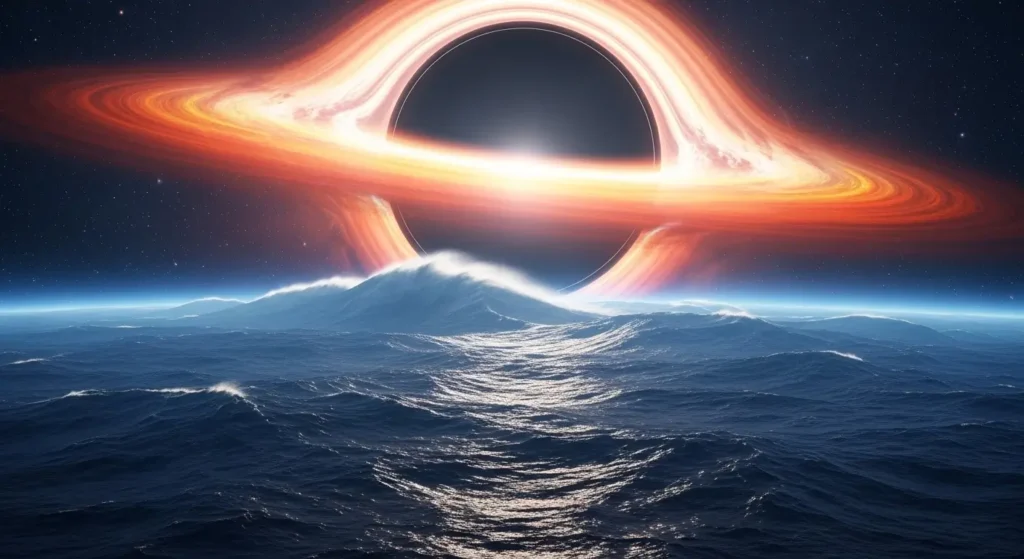
The stakes were terrifyingly high: “Every hour we spend on that planet is seven years back on Earth.”
When Cooper (Matthew McConaughey) and Brand (Anne Hathaway) return to their ship after a disastrously short mission, they find their crewmate Romilly has aged by 23 years. It’s a heartbreaking moment, but is it science or just fiction? As a space enthusiast and physics geek, I dug into the research—including the work of Nobel Prize-winning physicist Kip Thorne—to bring you the ultimate fact-check. 🚀
1. Visualizing Gargantua: A Black Hole Masterpiece 🌌
Before we land on the planet, we must talk about the monster it orbits. Gargantua is a supermassive black hole with a mass 100 million times that of our Sun.
The visual representation of Gargantua wasn’t just CGI magic; it was a scientific breakthrough. Kip Thorne provided the actual equations of General Relativity to the visual effects team at Double Negative (DNEG).
💡 Did You Know?
The glowing ring you see around the black hole is the Accretion Disk. The light bends over and under the black hole due to Gravitational Lensing, creating that iconic “halo” shape. The simulation was so accurate that it actually led to the publication of scientific papers!
However, there was one scientific compromise. In reality, the Doppler Effect would make one side of the disk blindingly blue and bright (as it spins towards you) and the other side dim and red (spinning away). Nolan chose to tone this down to avoid confusing the audience, keeping the brightness relatively uniform.
2. The Time Dilation Reality Check ⏳
Now, to the core question: Is such extreme time dilation possible?
According to Einstein’s Theory of General Relativity, massive objects warp spacetime. The stronger the gravity, the slower time moves relative to a distant observer. This phenomenon is called Gravitational Time Dilation.
To achieve a time dilation factor of roughly 60,000 (where 1 hour equals ~60,000 Earth hours, or 7 years), Miller’s Planet essentially has to be orbiting on the edge of destruction.
- ✅ The Verdict: Theoretically Possible, but highly unlikely.
- For this math to work, the planet must be orbiting extremely close to the Event Horizon (the point of no return). Kip Thorne calculated that the black hole must be spinning at 99.999999998% of the speed of light. This incredible spin drags spacetime around it, allowing the planet to orbit safely without falling in immediately.
3. The Problem with Miller’s Planet: Tidal Forces 🌊
While the time dilation is mathematically sound (under extreme conditions), the existence of the planet itself is the bigger scientific stretch.
You remember the massive waves in the movie? Those are tidal waves caused by the black hole’s gravity. However, in reality, the gravitational difference between the “front” and “back” of the planet (tidal force) would be so immense that it would likely rip the planet apart before waves could even form.
In physics terms, the planet would undergo spaghettification or at least be heated to extreme temperatures by tidal friction, making it a molten hellscape rather than a water world.
🌍 Earth vs. Miller’s Planet Comparison
| Feature | Earth | Miller’s Planet |
|---|---|---|
| Time Flow | Standard (1 sec = 1 sec) | Slowed (1 hour ≈ 61,320 Earth hours) |
| Gravity | 1 G (9.8 m/s²) | 1.3 G (Heavy but walkable) |
| Orbiting | The Sun (Star) | Gargantua (Black Hole) |
| Primary Danger | Climate Change, Asteroids | 4,000ft Tidal Waves |
4. Real Science: Your Feet Are Younger Than Your Head 🦶
You don’t need a black hole to experience time dilation. It happens right here on Earth!
Because gravity is stronger closer to the Earth’s center, time moves slightly slower at sea level than it does on top of Mount Everest.
📌 Real-World Example: GPS Satellites
The GPS in your phone relies on satellites orbiting Earth. Because they are further from Earth’s gravity (and moving fast), their clocks tick faster than clocks on the ground by about 38 microseconds per day. If engineers didn’t adjust for this “Interstellar effect,” your GPS accuracy would drift by miles every single day!
🧮 Interstellar Time Calculator
Curious how much time you’d lose on Earth while visiting Miller’s Planet? Enter your stay duration below.Hours spent on Miller’s Planet:Calculate Earth Time
🌍 Time passed on Earth: 0 Years
Frequency Asked Questions (FAQ) ❓
Q: Could humans survive on Miller’s Planet?
A: Likely not. Apart from the giant waves, the radiation from the black hole’s accretion disk (X-rays and Gamma rays) would likely sterilize the planet, making it uninhabitable without heavy shielding.
Q: Is Plan B (embryos) scientifically feasible?
A: It’s biologically questionable. Raising 5,000 children with limited resources and lack of a diverse gut microbiome (which we inherit from mothers) would be a massive challenge. Genetic diversity is okay, but the logistics of survival are the real hurdle.
Q: Why didn’t they just park the ship further away?
A: They did! The main ship, Endurance, stayed far enough away to avoid the worst time dilation. Only the Ranger lander went down. Romilly waited on the Endurance, which is why he aged while Cooper and Brand didn’t.
Interstellar remains a landmark in “hard science fiction.” While it bends the rules for drama, the core concept that gravity shapes time is a proven fact of our universe.
Next time you look at the stars, remember: somewhere out there, time might be moving entirely differently.
Have more questions about space physics? Drop a comment below! 😊