Did the James Webb Telescope dash our hopes for life on TRAPPIST-1? Explore the latest data on its ‘habitable‘ planets and the new reality for our search.
Remember 2017? It feels like a lifetime ago, but for those of us who follow the stars, it was electric. NASA announced the discovery of TRAPPIST-1, a star system just 39 light-years away with not one, not three, but seven Earth-sized rocky planets. It was the holy grail—a potential “alien solar system” right in our cosmic backyard.
Three of these planets were in the “Goldilocks Zone,” that perfect orbital distance where liquid water could potentially exist on the surface. Our collective imagination went wild. We finally had a prime target, a place where, just maybe, we weren’t alone. All we had to do was wait for our next-generation tool to get a closer look.
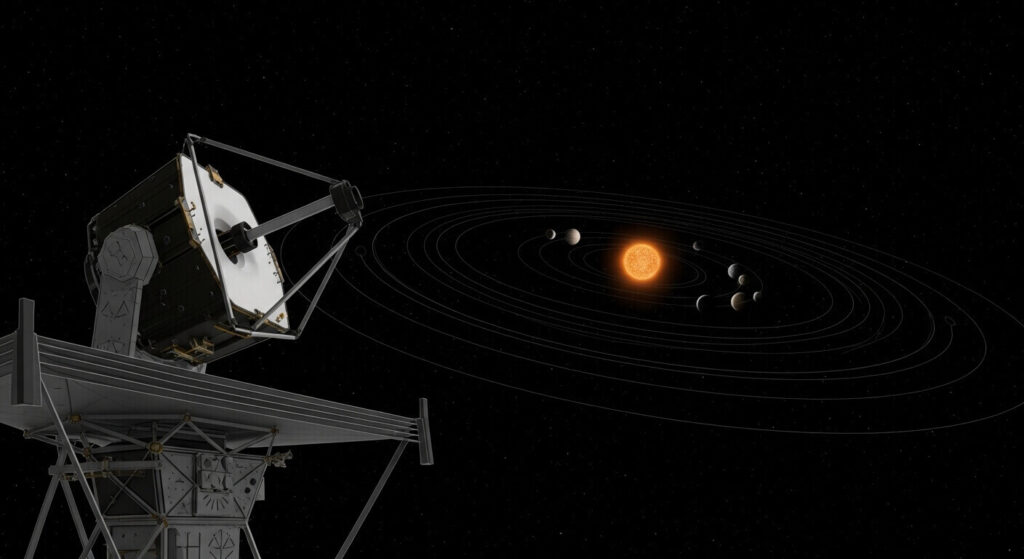
That tool, the James Webb Space Telescope (JWST), is now online. And it has turned its powerful golden eye toward TRAPPIST-1. The first results are in, and they are… well, they’re a cold dose of reality. The data JWST is sending back is forcing a sobering recalibration of our hopes and dramatically refining our entire strategy for the search for extraterrestrial life.
This isn’t the story of discovery we were hoping for. It’s something more complex, and perhaps, more important.
Table of Contents
- What Made the TRAPPIST-1 System So Special?
- The James Webb Telescope’s Cold Dose of Reality
- A First Look at TRAPPIST-1b and 1c: Bare Rock
- The Big One: TRAPPIST-1d’s “Flat” Spectrum
- The “Red Dwarf Problem”: A Fatal Flaw in the Search for Life?
- Vicious Flares and Atmospheric Stripping
- The Tidal Lock Trap: A World of Extremes
- This Isn’t Failure, It’s Science: Recalibrating the Search for Life
- Frequently Asked Questions (FAQ)
What Made the TRAPPIST-1 System So Special? 🤔
To understand the disappointment, you have to understand the hype. The TRAPPIST-1 system was a statistical miracle. Its star is an “ultracool M-dwarf” (a red dwarf), which is the most common type of star in our galaxy. If these stars could host life, the universe would be teeming with it.
And this system had it all:
- Seven Earth-Sized Planets: All were rocky, like Earth, Venus, or Mars.
- A “Perfect” Target for JWST: The star is small and dim, and the planets orbit very closely (all in orbits smaller than Mercury’s). This makes it much easier for a telescope like the James Webb to analyze their atmospheres using a technique called transmission spectroscopy.
- The Habitable Zone: Planets `d`, `e`, and `f` were all located in the star’s habitable zone, where temperatures could theoretically allow for liquid water.
It was the perfect laboratory. It was the place where we might, for the first time, find the chemical “biosignatures” (like oxygen, methane, and CO2) that signal a living world. Or so we thought.
The James Webb Telescope’s Cold Dose of Reality 📉
The James Webb Telescope doesn’t take a “photo” of the planet’s surface. It uses an instrument called a spectrometer. When a planet passes in front of its star (a “transit”), a tiny bit of starlight filters through the planet’s atmosphere. By analyzing which wavelengths of light are *absorbed* by that atmosphere, scientists can determine exactly what gases are present.
If a planet has a thick, CO2-rich atmosphere like Venus, it will create a huge, obvious signal. If it has an Earth-like atmosphere, it will create a smaller, but still detectable, signal. If it has no atmosphere at all (like Mercury), the starlight will pass through unobstructed, and the spectrometer will read a flat line.
The TRAPPIST-1 results have been, almost universally, flat lines.
A First Look at TRAPPIST-1b and 1c: Bare Rock
JWST started with the two innermost planets, `1b` and `1c`. These are too hot to be habitable, but they served as a crucial test. They are close enough to their star that they were expected to have thick, hot, Venus-like atmospheres of carbon dioxide. If JWST couldn’t find *those*, it would be a bad sign.
The results, published in 2023, were a shock. Both TRAPPIST-1b and 1c appear to be bare rock. The data showed no evidence of any significant atmosphere at all. They are not like Venus. They are more like Mercury, or the Moon—scorched, airless worlds. This was the first red flag.
The Big One: TRAPPIST-1d’s “Flat” Spectrum
Then came the main event: TRAPPIST-1d. This planet is the innermost planet in the system’s habitable zone. It receives a similar amount of energy to what Earth receives from the Sun. This was the one we were pinning our hopes on. Scientists were looking for anything—water, CO2, methane.
The result? Another flat line. The data, analyzed by research teams across the U.S. and Europe, shows no evidence of a thick, hydrogen-dominated atmosphere. It also rules out a thick, CO2-rich atmosphere like Venus.
While this doesn’t *completely* rule out a thin, Earth-like atmosphere (that might be too small for even JWST to see yet), it’s the worst-case scenario. The most likely conclusion is that TRAPPIST-1d is also an airless rock, perhaps more like Mars. A planet with no atmosphere, or one that is vanishingly thin, cannot have stable liquid water on its surface. It cannot host life as we know it.
The “Red Dwarf Problem”: A Fatal Flaw in the Search for Life? 🌋
So, what happened? Why are these planets, which *should* have atmospheres, all barren? The culprit is likely the star itself. This is the “Red Dwarf Problem.”
Red dwarfs (M-dwarfs) are the most common stars, but they are notoriously violent, especially in their youth.
Vicious Flares and Atmospheric Stripping
TRAPPIST-1 is an active star. It constantly erupts with powerful solar flares and coronal mass ejections, bathing its planets in high-energy X-rays and UV radiation. Our Sun does this too, but Earth is 93 million miles away and protected by a strong magnetic field.
The TRAPPIST-1 planets aren’t so lucky. To stay warm enough for liquid water, they must orbit incredibly close to their dim star. TRAPPIST-1d, in the “habitable zone,” has an orbit that lasts just 4 Earth days. Over billions of years, this constant, close-range bombardment of radiation would have effectively “sandblasted” the atmospheres off these planets, stripping them away into space.
The Tidal Lock Trap: A World of Extremes
There’s another problem: tidal locking. Just as our Moon always shows the same face to Earth, planets orbiting this closely to their star become tidally locked. One side of the planet is trapped in eternal, scorching daylight, while the other side is in eternal, freezing night.
Even if a planet *could* hold onto an atmosphere, this creates a world of extremes. Any water on the dayside would boil off, while any water on the nightside would freeze into a giant ice cap. This makes the “liquid water” part of the habitable zone definition extremely difficult to achieve. It seems the very conditions that make these planets warm enough for life also make them fundamentally uninhabitable.
This Isn’t Failure, It’s Science: Recalibrating the Search for Life 🔭
So, is it game over for the search for life? Absolutely not. In fact, this is a monumental scientific success. We built a $10 billion telescope to answer the question, “Do these planets have atmospheres?” And it has given us an answer: “Probably not.”
A “null result” is still a result. This is how science works. The TRAPPIST-1 findings are not a failure; they are a critical data point. They tell us that ultracool red dwarf systems, while common, might be poor candidates for life. This is vital information that will shape the search for decades.
The search doesn’t end here. The James Webb Telescope will continue its observation of the outer TRAPPIST-1 planets (`e`, `f`, and `g`). Perhaps they were far enough away to hold on to some of their atmosphere. But scientists are also pivoting. The search for extraterrestrial life may now shift away from M-dwarfs and toward stars more like our own (G-dwarfs) or their slightly cooler, calmer cousins (K-dwarfs).
We hoped TRAPPIST-1 would be a shortcut. It wasn’t. The universe, it seems, isn’t going to make it that easy for us. The search for life continues, but now, thanks to the James Webb Telescope, we are searching with our eyes wide open, armed with a new and sobering dose of reality.
Frequently Asked Questions (FAQ) ❓
Q: Did the James Webb Telescope prove there is no life in the TRAPPIST-1 system?
A: No. JWST cannot detect life itself. It searches for atmospheres and their chemical composition. The current data strongly suggests that the inner planets, including `1d` in the habitable zone, likely have no significant atmosphere. Without an atmosphere, life *as we know it* (which requires liquid water) cannot exist on the surface. It hasn’t ruled out life on the outer planets (`e`, `f`, `g`) yet, but the outlook is less optimistic.
Q: What does a “flat spectrum” mean in astronomy?
A: A “flat spectrum” is a term used in transmission spectroscopy. It means that when the planet passed in front of its star, the starlight was not filtered or absorbed in any detectable way. This indicates the planet has no significant atmosphere to absorb the light. It’s the signal you would expect from a bare ball of rock, like Mercury or the Moon.
Q: What is the “Goldilocks Zone” (Habitable Zone)?
A: The Habitable Zone, or “Goldilocks Zone,” is the orbital region around a star where the temperature is “just right”—not too hot and not too cold—for liquid water to exist on a planet’s surface. However, this definition assumes the planet has an atmosphere thick enough to maintain that water. As the TRAPPIST-1 findings show, being in the zone is not a guarantee of habitability.
Q: Why are red dwarf stars considered bad for hosting life?
A: While they are the most common stars, they have two major problems. First, they are extremely violent, especially when young, emitting powerful X-ray and UV flares that can strip atmospheres from nearby planets. Second, because they are so dim, a planet must orbit very closely to be in the habitable zone. This close orbit causes the planet to become “tidally locked,” with one side perpetually facing the star (scorching hot) and one side in perpetual darkness (freezing cold).
Q: If TRAPPIST-1 is a bust, where does the search for life go next?
A: The search is far from over! This data helps scientists refine their strategy. The search will likely pivot to focusing more on planets around calmer, more Sun-like stars (G-dwarfs) or their slightly cooler cousins (K-dwarfs). JWST is also observing many other types of exoplanets, and future telescopes will be designed with this new “red dwarf problem” in mind.