Why was Pluto stripped of its planet status? Discover the scientific truth behind Pluto’s demotion to a dwarf planet, the IAU’s controversial 2006 decision, and the mind-blowing discoveries from NASA’s New Horizons mission that prove Pluto is more alive than we ever imagined.
Table of Contents
- 1. Introduction: The Day the Solar System Shrank
- 2. The IAU 2006 Definition: The 3 Rules of Planethood
- 3. Why Pluto Failed: The “Neighborhood” Problem
- 4. New Horizons: A World Reborn in 2015
- 5. The Beating Heart and Cryovolcanoes
- 6. The Hidden Liquid Ocean at the Edge of Space
- 7. Frequently Asked Questions (FAQ)
For decades, school children around the world memorized the nine planets of our solar system, ending with the small, icy outlier: Pluto. However, in 2006, the astronomical world was set ablaze when the International Astronomical Union (IAU) officially “demoted” Pluto. To many, it felt like losing a member of the family. Why was Pluto stripped of its planet status after 76 years of recognition? Was it just too small, or was there a deeper scientific shift at play? 😊
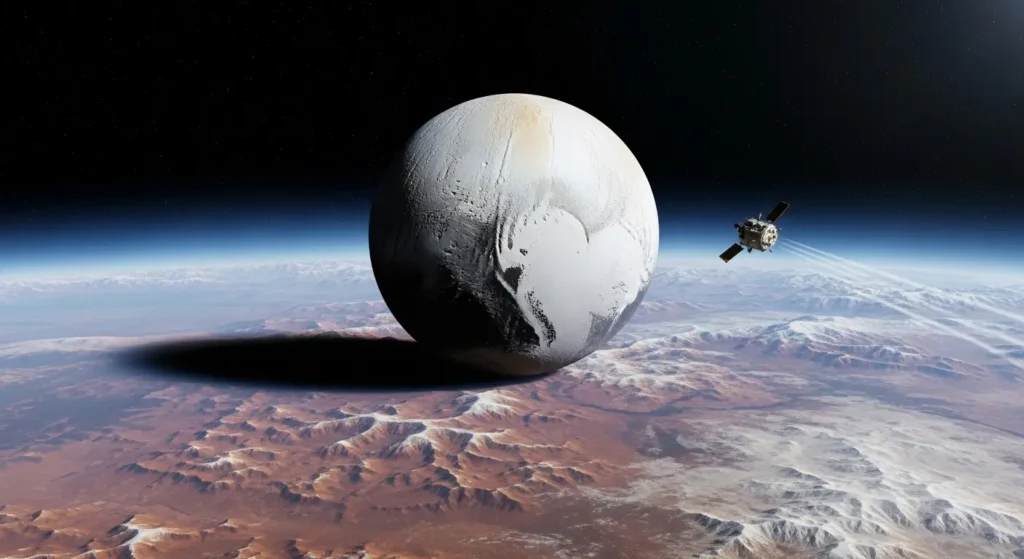
If you’ve ever felt a bit protective of our distant icy friend, you’re not alone. But as we dive into the data provided by modern telescopes and the historic 2015 New Horizons flyby, we realize that Pluto’s new title as a “dwarf planet” doesn’t make it any less spectacular. In fact, it might be one of the most geologically active and mysterious places in our celestial neighborhood.
The IAU 2006 Definition: The 3 Rules of Planethood 🔭
To understand why Pluto was stripped of its planet status, we must look at the legalities of space. Before 2006, there was no formal scientific definition of a “planet.” It was simply understood. But as technology improved, astronomers began finding objects in the Kuiper Belt (the region beyond Neptune) that were remarkably similar to Pluto.
What makes a planet? 📝
The IAU established three specific criteria that a celestial body must meet to be called a planet:
- It must orbit the Sun.
- It must have sufficient mass to assume a nearly round shape (hydrostatic equilibrium).
- It must have “cleared the neighborhood” around its orbit.
Why Pluto Failed: The “Neighborhood” Problem 🛰️
Pluto easily checks boxes one and two. It orbits our Sun and is a beautiful sphere. The controversy lies entirely with Rule Number 3. “Clearing the neighborhood” means that the planet must be the dominant gravitational force in its orbital path, having either consumed or kicked away other smaller objects.
Pluto is located in the Kuiper Belt, a crowded zone of icy debris. It shares its orbital space with thousands of other objects and, most notably, its own moon, Charon. Because Charon is about half the size of Pluto, the two actually orbit a common point in space between them, acting more like a binary system than a dominant planet and its satellite. Therefore, Pluto failed to “clear its neighborhood,” leading to its reclassification as a dwarf planet.
💡 Did you know?
The discovery of Eris in 2005 was the “final straw.” Eris was thought to be more massive than Pluto, forcing astronomers to either accept a 10th planet (and potentially hundreds more) or redefine what a planet actually is.
New Horizons: A World Reborn in 2015 🚀
While the scientific community debated labels, NASA’s New Horizons spacecraft was racing toward the edge of the solar system. When it finally reached Pluto in July 2015, the images it sent back were nothing short of revolutionary. We expected a cold, crater-pocked, dead rock. Instead, we found a vibrant, colorful, and complex world.
| Feature | Pre-2015 Assumption | Post-2015 Reality |
|---|---|---|
| Geology | Cold and inactive | Dynamic and flowing glaciers |
| Surface Age | Ancient, billions of years old | Very young in parts (less than 10M years) |
| Atmosphere | Non-existent or negligible | Layered, blue haze atmosphere |
The Beating Heart and Cryovolcanoes ❤️
The most iconic feature of Pluto is the giant, heart-shaped glacier known as Tombaugh Regio. Specifically, the western lobe, Sputnik Planitia, is a vast plain of nitrogen ice. What shocked scientists was the total lack of impact craters in this region. This means the surface is being constantly renewed, behaving like a “beating heart” of geological activity.
⚠️ Mind-Blowing Fact:
Pluto has ice volcanoes (cryovolcanoes)! Instead of molten rock (magma), these mountains, like Wright Mons, erupt a slushy mix of water, ice, and nitrogen. This requires an internal heat source that we didn’t think existed so far from the Sun.
The Hidden Liquid Ocean at the Edge of Space 🌊
Perhaps the most profound discovery is what lies beneath Pluto’s crust. Based on the orientation of Pluto’s orbit and the weight of Sputnik Planitia, researchers have concluded that Pluto likely harbors a liquid water ocean 100 to 180 kilometers beneath the surface.
How can water stay liquid at -230°C? Scientists believe that a combination of radioactive decay in Pluto’s rocky core and an insulating layer of gas hydrates (gas-trapped ice) acts as a thermal blanket. This transforms our view of Pluto from a “dead rock” to a potential candidate for extraterrestrial life. If liquid water exists at the edge of our solar system, it could be everywhere in the universe.
💡 Pluto Demotion Summary
✅
Scientific Reason: Pluto failed to “clear its neighborhood” in the Kuiper Belt.
✅
New Horizons Flyby: Revealed a world with blue skies, red snow, and flowing glaciers.
✅
Geological Life: Active ice volcanoes and a massive nitrogen-ice heart (Sputnik Planitia).
✅
Liquid Ocean: Strong evidence for a subsurface ocean, expanding the search for life.
Frequently Asked Questions (FAQ) ❓
Q: Is Pluto still a planet?
A: Officially, no. The IAU classifies Pluto as a dwarf planet. However, many planetary scientists argue that the definition is flawed and still consider it a planet.
Q: Why was Pluto stripped of its planet status specifically in 2006?
A: The discovery of Eris, which was thought to be larger than Pluto, forced a vote. If Pluto remained a planet, then Eris, Ceres, and many others would have to be planets too.
Q: Could Pluto become a planet again?
A: Scientific classifications change with new data. There is an ongoing effort by many scientists to change the definition of a planet to be based on physical properties rather than orbital mechanics.
The story of Pluto is far from over. Whether we call it a planet or a dwarf planet, its complexity and beauty remain unchanged. What do you think? Should Pluto be reinstated as the ninth planet? Let us know in the comments below! 🚀✨