Can you imagine a monster that eats galaxies? We break down the massive TON 618 black hole size compared to solar system to visualize the scale of the universe’s largest known abyss. 🌌
Let’s be honest for a second. When we think of “big,” our brains usually stop at things like Mount Everest, the Pacific Ocean, or maybe the Sun. Even the Sun, which creates 99.8% of our solar system’s mass, is difficult to truly comprehend. But out there in the deep dark of the Canes Venatici constellation, there is something that makes our Sun look like a sub-atomic particle.
I’m talking about TON 618. It’s not just a black hole; it’s an ultramassive monster that defies the laws of what we thought was possible.
If you’ve ever laid in bed wondering just how small we are, you’ve come to the right place. Today, we aren’t just throwing numbers at you. We are going to visualize the TON 618 black hole size compared to solar system in a way that might just give you a slight existential crisis (in a good way, I promise! 😊).
Table of Contents
- 1. What Exactly is TON 618?
- 2. The Scale: TON 618 Mass vs The Sun
- 3. TON 618 Black Hole Size Compared to Solar System
- 4. Visualizing the Abyss: A Thought Experiment
- 5. Quick Data: Solar System vs TON 618
- 6. Frequently Asked Questions
What Exactly is TON 618? 🤔
Before we measure it, we need to know what we are looking at. TON 618 is technically a hyperluminous broad-absorption-line radio-quiet quasar. That’s a mouthful of astronomical jargon, but simply put: it is a swirling vortex of superheated gas circling a black hole, shining brighter than 140 trillion suns.
It is located about 10.4 billion light-years away. This means we are seeing it as it was when the universe was much younger. The fact that a black hole grew this large so early in the universe’s history is actually a major problem for astrophysicists—it shouldn’t theoretically be this big, yet there it is.
💡 Key Insight:
When we talk about the “size” of a black hole, we are usually referring to the Schwarzschild radius (the Event Horizon). This is the point of no return. Once you cross this line, not even light can escape.
The Scale: TON 618 Mass vs The Sun ⚖️
To understand the TON 618 black hole size compared to solar system, we first have to weigh it. In astronomy, we use “Solar Masses” ($M_\odot$) as a unit. One Solar Mass equals the weight of our Sun.
Most black holes we find are “stellar-mass” black holes, maybe 10 to 100 times the mass of the Sun. Then you have “supermassive” black holes, like Sagittarius A* at the center of our Milky Way, which is about 4.3 million solar masses.
TON 618 is in a league of its own.
It is estimated to be 66 billion solar masses. Yes, billion with a “B”.
- Milky Way’s Black Hole: 4.3 Million Suns
- Andromeda’s Black Hole: 100 Million Suns
- TON 618: 66,000 Million (66 Billion) Suns
If Sagittarius A* is a marble, TON 618 is the size of a planet. The sheer density required to pack that much matter into a single point creates an Event Horizon of terrifying proportions.
TON 618 Black Hole Size Compared to Solar System 🌌
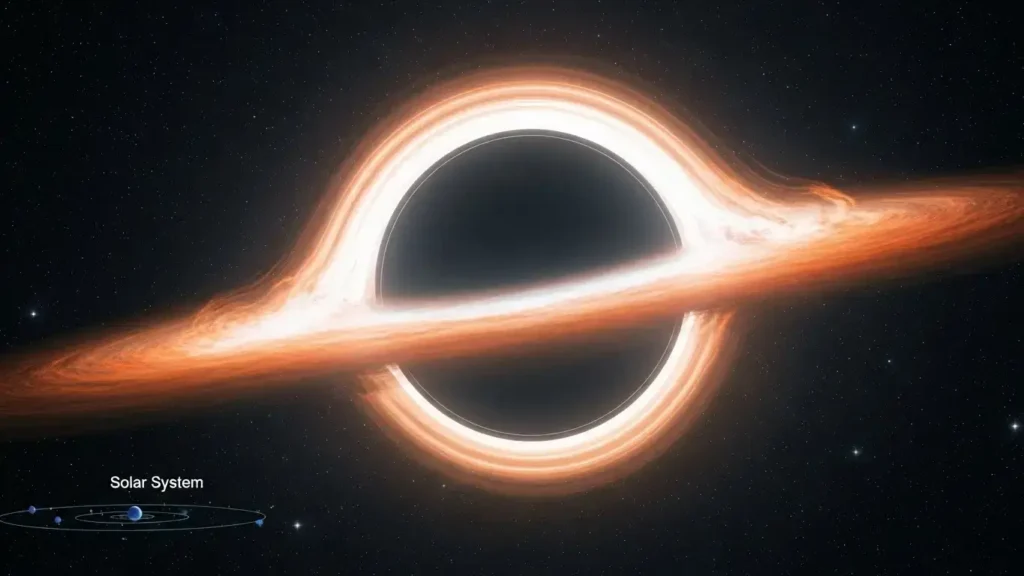
Now, let’s get to the visual part. This is where the human brain usually starts to short-circuit. If we placed TON 618 at the center of our Solar System, replacing the Sun, what would happen?
The Diameter of the Abyss
The diameter of TON 618’s event horizon is approximately 390 billion kilometers (about 242 billion miles). Let’s put that into perspective using Astronomical Units (AU), where 1 AU is the distance from Earth to the Sun.
- Distance to Earth: 1 AU
- Distance to Neptune (edge of planetary system): 30 AU
- Distance to Voyager 1 (farthest human object): ~162 AU
- TON 618 Radius: ~1,300 AU
If TON 618 were placed in our solar system, its event horizon wouldn’t just swallow Earth. It wouldn’t just swallow Jupiter. It would extend 40 times further out than Neptune.
It would swallow the entire planetary system, the Kuiper Belt, and a massive chunk of the scattered disc. Voyager 1, which has been traveling at 38,000 mph for over 45 years, would still be deep inside the black hole, nowhere near the exit (if there was one).
⚠️ Mind-Bending Fact:
It takes light from the Sun about 5.5 hours to reach Pluto. To cross the diameter of TON 618, it would take light roughly two weeks. That is a single object so large that light takes weeks to travel across its shadow.
Visualizing the Abyss: A Thought Experiment 🧠
Numbers are great, but analogies are better. Let’s try to scale this down to objects we can hold or see.
Imagine the Sun is a single grain of fine sand (about 1mm wide).
On this scale:
- Earth is a microscopic speck of dust orbiting 10cm away.
- Neptune is orbiting about 3 meters (10 feet) away.
- TON 618, in comparison, would be a sphere roughly 280 meters (918 feet) wide.
Imagine a grain of sand sitting next to the Eiffel Tower or the Chrysler Building. That building is the black hole. The grain of sand is our Sun. That is the terrifying reality of the TON 618 black hole size compared to solar system.
Quick Data: Solar System vs TON 618 📊
For those who love the raw data, here is the direct comparison breakdown.
| Object | Diameter (km) | Scale Comparison |
|---|---|---|
| The Sun | ~1.4 Million km | Base Unit (1) |
| Neptune’s Orbit | ~9 Billion km | ~6,400x Sun |
| TON 618 | ~390 Billion km | ~278,000x Sun |
Looking at this table, it’s easy to feel insignificant. But remember, we are the species that built the instruments to find and measure this beast across 10 billion light-years of darkness. That counts for something, right?
Frequently Asked Questions ❓
Q: Is TON 618 the largest black hole ever discovered?
A: Currently, yes. While there is a potential candidate named Phoenix A* that theoretical models suggest could be larger (up to 100 billion solar masses), TON 618 remains the largest confirmed ultramassive black hole based on spectral measurements.
Q: Could TON 618 swallow the Milky Way galaxy?
A: No. While TON 618 is huge compared to the Solar System, it is still tiny compared to a galaxy. The Milky Way is 100,000 light-years across. TON 618 is “only” light-weeks across. However, its gravity would disrupt the galaxy significantly if placed in the center.
Q: How do we know the TON 618 black hole size?
A: Scientists measure the speed of gas swirling around the central region (the accretion disk). By analyzing the redshift and width of spectral lines, they can calculate the velocity of the gas and use the laws of gravity to determine how much mass must be in the center to keep that gas moving so fast.
Q: Will TON 618 keep growing?
A: Likely, yes. Black holes grow by consuming matter (accretion) and merging with other black holes. Since we see TON 618 as it was 10 billion years ago, it has likely grown even larger or merged with others in the time since.
The universe is full of monsters, but TON 618 reminds us just how extreme the cosmos can get. Understanding the TON 618 black hole size compared to solar system isn’t just about big numbers; it’s about expanding our perspective of reality.
If this mind-bending comparison sparked your curiosity, share it with a friend who loves space! Got more questions about the cosmos? Drop them in the comments below! 🚀